Pork Internal Temp
Quick answer
Whole cuts of pork, like chops, loin roasts and tenderloin, are safe at 145°F (63°C) measured in the thickest part, followed by a 3-minute rest. At 145°F the center can still look slightly pink, and that's fine. Ground pork and fresh pork sausage need 160°F (71°C). Pork shoulder and ribs are safe at 145°F too, but they only turn pull-apart tender around 195–205°F (91–96°C), which is a texture choice.
Handy for this: Internal temperature chart · Ham cooking time calculator
Part of our Food safety temperatures (safe temperatures, storage times and thawing in one chart) hub.
At a glance
- Start checking a few minutes before the low end of your recipe time.
- Slide an instant-read thermometer into the side of the chop or roast, so the tip sits in the very center of the thickest part.
- Keep the probe away from bone and big pockets of fat.
- Move the probe slightly in and out and read the lowest number.
- Pull whole cuts at 145°F (63°C), or a few degrees lower for big roasts that will keep rising.
- Rest the pork at least 3 minutes before slicing; cook ground pork to 160°F (71°C) with no rest needed.
The short version
Pork chops, pork loin and pork tenderloin are done at 145°F (63°C) in the thickest part, followed by a 3-minute rest. That's USDA's safe minimum for whole cuts of pork, and it gives you juicy meat with a faint blush of pink in the middle.
Ground pork and fresh pork sausage are different: they need 160°F (71°C). And big, tough cuts like shoulder and ribs are safe at 145°F too, but they only get fall-apart tender once they reach about 195–205°F (91–96°C). That higher number is about texture, not safety.
Pork internal temperature chart
Here's every common cut in one place. For beef, chicken, fish and eggs, the doneness temperatures chart has the full list.
| Cut | Safe minimum | What many cooks aim for | Rest |
|---|---|---|---|
| Pork chops (bone-in or boneless) | 145°F (63°C) | 145°F (63°C) | 3 minutes |
| Pork tenderloin | 145°F (63°C) | 145°F, pulled near 140°F | 3–5 minutes |
| Pork loin roast | 145°F (63°C) | 145°F, pulled near 140°F | 10–15 minutes |
| Fresh (raw) ham | 145°F (63°C) | 145°F (63°C) | 3 minutes or more |
| Ground pork, meatballs, fresh sausage | 160°F (71°C) | 160°F (71°C) | None needed |
| Pork shoulder (pulled pork) | 145°F (63°C) | 195–205°F (91–96°C) | 30–60 minutes |
| Pork ribs | 145°F (63°C) | 190–203°F (88–95°C) | 10 minutes |
| Fully cooked ham, factory-sealed | Reheat to 140°F (60°C) | 140°F (60°C) | None needed |
| Cooked ham repackaged, and all leftovers | Reheat to 165°F (74°C) | 165°F (74°C) | None needed |
Planning a holiday ham? The ham cooking time calculator gives you minutes by weight and type.
How to check pork's temperature
- Use an instant-read thermometer. A thin digital probe reads in a few seconds and leaves a small hole.
- Go in from the side. For a chop, slide the probe in through the edge so the tip lands in the center of the thickest part. Poking down from the top often puts the tip in the pan.
- Avoid bone and fat. Bone reads warmer or cooler than the meat around it, and a pocket of fat can fool the reading.
- Find the lowest number. Ease the probe in and out a little. The coolest spot is the true center.
- Pull and rest. Take whole cuts off at 145°F and rest them at least 3 minutes. A big roast can come out around 140°F, since it will climb 5 degrees or so while it rests. Check again after resting to be sure it reached 145°F.
Chops, tenderloin and loin
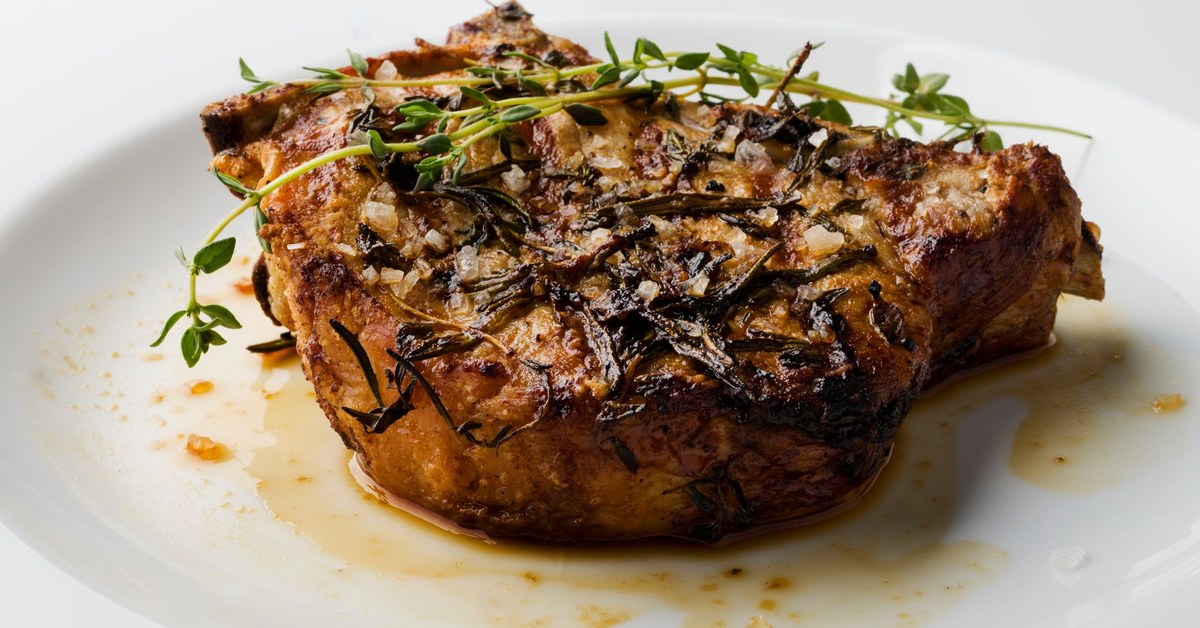
Pork chop internal temp
A 1-inch chop on the stove takes about 8 to 10 minutes total over medium-high heat, flipping once. Thin chops (½ inch) can reach 145°F in 5 to 6 minutes, so start checking early. Our guide on how to cook pork chops on the stove walks through the sear, the flip and a quick pan sauce.
Pork tenderloin internal temp
Tenderloin is lean and slim, so it moves from 140°F to 150°F quickly. Most cooks sear it in a skillet and finish it in a 400°F (205°C) oven, pulling it right around 140–145°F. The full method is in how to cook pork tenderloin.
Pork loin roast
A boneless loin roast is wider and holds more heat, so it carries over more. Pull it around 140°F, tent it loosely with foil, and rest 10 to 15 minutes. It should settle at 145°F or a little above. See how to cook pork loin for roasting times by weight.
Cut by cut: pork loin internal temp for roasts, pork tenderloin internal temp for the small, fast cut, and pork chop internal temp.
Ground pork, sausage and meatballs
Anything ground needs 160°F (71°C). That includes patties, meatballs, meatloaf and raw sausage links. When meat is ground, whatever was on the surface gets mixed into the middle, so the center has to get hotter than a whole chop does.
In the skillet, ground pork crumbles turn from pink to an even tan with golden edges in about 8 to 10 minutes. The juices run clear. Color is only a hint, though, so check a thick crumble or the center of a patty. Our guide on how to cook ground pork covers browning and seasoning.
Pulled pork and ribs: the texture numbers
Pork shoulder is safe at 145°F, but at that point it's firm and chewy. It's full of connective tissue that slowly melts into gelatin as the meat sits between about 160°F and 205°F for hours. That's why pulled pork targets are so much higher.
- Sliceable shoulder: around 185–190°F (85–88°C).
- Pulled pork: 195–205°F (91–96°C). Many cooks aim for about 203°F.
- Ribs: 190–203°F (88–95°C), when the meat pulls back from the bone ends.
Expect a stall somewhere around 150–170°F, where the temperature seems stuck for an hour or more. That's moisture cooling the surface, and it passes. Rest a pulled pork shoulder 30 to 60 minutes, wrapped, before shredding.
“Both sides of that chop are deep golden and it's been about 8 minutes. Grab the thermometer and check the center for 145°F.”
For the full method, wrapped low and slow, see how to cook ribs in the oven.
How to tell when pork is done
The thermometer has the final word. These cues tell you when it's time to reach for it.
Sight
- A chop's edges turn from pink to opaque and creep up the sides. When they're about halfway up, it's time to flip.
- Both sides have a deep golden crust and the juices on top run clear with a light tint.
- At 145°F, the center can look pale pink. That's normal and safe.
Sound
- A steady, lively sizzle means the pan is at a good temperature. When the sizzle softens and the pan goes quieter, the surface moisture has cooked off and the crust is setting.
Smell
- A toasty, browned aroma means the crust is building. If it starts to smell sharp or smoky, lower the heat.
Touch
- Press the center of a chop with tongs. Soft and squishy means it needs more time. Springy and just firm means it's close.
- For pulled pork, a fork should twist in the meat with almost no resistance, and the bone should slide out clean.
Temperature
145°F (63°C) plus a 3-minute rest for whole cuts, 160°F (71°C) for ground pork. On the stovetop, this is exactly the moment Pan watches for: the crust is deep golden, the clock says you're close, and it tells you to check the center.
Leftovers and reheating
Refrigerate cooked pork within 2 hours, in shallow containers so it cools quickly. Eat it within 3 to 4 days, or freeze it for later. Reheat leftovers to 165°F (74°C). A splash of broth in a covered skillet over medium-low keeps sliced pork or pulled pork moist. The reheating guide has times for the stovetop, oven and microwave.
Cooking chicken tonight instead? Dark meat has its own sweet spot, covered in our guide to chicken thigh internal temp.
Pork cooking times by cut
Whole cuts are safe at 145°F (63°C) with a rest; ground pork at 160°F (71°C). Shoulder and ribs are cooked far past that, until the connective tissue melts.
| Cut | Method | Time | Done at |
|---|---|---|---|
| Chops, 1 inch | Oven, 400°F | 15–25 min | 145°F · guide |
| Tenderloin | Sear, then 400°F | 12–20 min | 145°F · guide |
| Boneless loin roast | Oven, 375°F | About 20 min per lb | 145°F · guide |
| Baby back ribs | Oven, 275°F, wrapped | 2½–3 hours | 190–203°F · guide |
| Shoulder (pulled pork) | Smoker or oven, 225–275°F | 1½–2 hours per lb | 195–205°F |
| Ground pork, sausage | Skillet, medium | 8–10 min | 160°F |
Internal temps for other meats
The same rule of thumb for everything else you cook: these are USDA safe minimums, with the pull point or texture target where it differs.
| Guide | Done at |
|---|---|
| Chicken internal temp | 165°F (74°C) Every cut, whole bird |
| Chicken breast internal temp | 165°F (74°C) Pull at 160–162°F, rest 5 min |
| Chicken thigh internal temp | 165°F (74°C) Most tender at 175–185°F |
| Turkey internal temp | 165°F (74°C) Breast, thigh and wing |
| Steak internal temp | 145°F (63°C) USDA Medium-rare 130–135°F |
| Prime rib internal temp | 145°F (63°C) USDA Pull at 120°F for medium-rare |
| Brisket internal temp | 145°F (63°C) safe Tender at 195–205°F |
| Burger internal temp | 160°F (71°C) 165°F for turkey or chicken |
| Meatloaf internal temp | 160°F (71°C) 165°F for turkey or chicken |
| Pork chop internal temp | 145°F (63°C) Pull thick chops near 140°F |
| Pork loin internal temp | 145°F (63°C) Pull roasts at 140°F |
| Pork tenderloin internal temp | 145°F (63°C) Pull at about 142°F |
| Salmon internal temp | 145°F (63°C) USDA Many cooks pull at 125–130°F |
Pan watches it for you
Pan tells you when to check the chop
Pan can't read the inside of the meat, but it watches the pan. On the stove it sees the crust build on a pork chop or tenderloin, keeps the clock, and tells you when to flip and when to reach for the thermometer.
- Edges of the chop turning opaque about halfway up: time to flip
- Deep golden crust on both sides: check the center for 145°F
- Ground pork crumbles with no pink left and clear juices: check for 160°F
- Pan juices darkening fast: turn the heat down a notch
Pan AI is on iPhone • Android.
Common questions
What is the internal temp of pork when done?
USDA says whole cuts of pork are done at 145°F (63°C) with a 3-minute rest. Ground pork is done at 160°F (71°C). Shoulder and ribs are safe at 145°F but most cooks take them much higher for tenderness.
Is it okay if pork is a little pink?
Yes. A pork chop or tenderloin at 145°F often has a blush of pink in the center, and it's safe when the thermometer says so. Color isn't a reliable signal either way, so trust the temperature.
Why is ground pork 160°F but pork chops 145°F?
Grinding mixes surface bacteria all through the meat, so the center has to get hotter. On a whole chop or roast, bacteria sit mostly on the outside, which the pan or oven heats well past 145°F.
What temperature is pulled pork done?
Pulled pork is safe at 145°F, but the shoulder only shreds easily once its collagen breaks down, usually at 195–205°F (91–96°C). Many cooks aim for about 203°F and test by twisting a fork in the meat.
Should I pull pork tenderloin at 140°F?
Many cooks take tenderloin off the heat around 140°F and let carryover finish it, but it still has to reach 145°F. Check again after the rest, and give it a few more minutes if it falls short.
How long does cooked pork last in the fridge?
Refrigerate cooked pork within 2 hours and eat it within 3–4 days. Reheat leftovers to 165°F (74°C).
What is pork internal temp in Celsius?
Whole cuts of pork are safe at 63°C (145°F) with a 3-minute rest. Ground pork and fresh sausage need 71°C (160°F).
What is the internal temp of pork loin?
Pork loin is done at 145°F (63°C). Pull a roast near 140°F and rest it 10–15 minutes; it climbs the rest of the way.
What temperature is pork belly done?
Pork belly is safe at 145°F, but it is cooked to about 190–200°F so the fat renders and the meat turns tender, then the skin is crisped at high heat.
Sources
- USDA FSIS: Safe Minimum Internal Temperature Chart
- USDA FSIS: Fresh Pork from Farm to Table
- FoodSafety.gov: Safe Minimum Internal Temperatures
- USDA FSIS: Leftovers and Food Safety
Reviewed against USDA FSIS and FoodSafety.gov guidance. How we choose sources and fix mistakes: editorial policy.
Keep cooking
- Meat & poultryHow to Cook Pork Chops on the StoveCook pork chops on the stove in 8 to 14 minutes: sear over medium-high, flip, and pull at 140°F so they rest to a juicy 145°F. Times for every thickness.
- Thanksgiving & holidaysHow to Cook Pork TenderloinSear pork tenderloin on all sides, roast at 400°F for 12–20 minutes until it reaches 145°F, then rest 3 minutes. Juicy, rosy slices on a weeknight.
- Meat & poultryHow to Cook Ground PorkBrown ground pork in a hot skillet over medium-high heat for 8–10 minutes, breaking it up, until no pink remains and it reaches 160°F. Steps and cues.
- Start hereHow to Tell When Food Is DoneHow to tell when chicken, steak, fish, chorizo, eggs, pasta, rice, cheesecake and pecan pie are done, with safe temperatures and simple sight and touch cues.
- Meat & poultryHow to Cook Duck BreastScore duck breast skin, start it skin-side down in a cold pan and render 10–15 minutes over medium-low, then flip for 1–3 minutes. USDA temp and doneness cues.
- Meat & poultryHow to Cook Ground ChickenBrown ground chicken in an oiled skillet over medium-high for 8–10 minutes, breaking it up, until no pink remains and it reaches 165°F (74°C). Tips and times.
- Free toolInternal temperature chartSafe and perfect internal temperatures for steak, chicken, salmon, pork and more, plus a printable PDF.
- Free toolHam cooking time calculatorSpiral, bone-in, boneless or fresh ham: minutes per pound, done temps and glaze timing.