Steak Internal Temp
Quick answer
USDA's safe minimum for steak is 145°F (63°C) in the center, followed by a 3-minute rest, which lands at medium. Many cooks choose lower doneness: medium-rare finishes at 130–135°F (54–57°C), so take the steak off the heat around 125–130°F and let carryover add the last few degrees. Rare finishes near 125°F (52°C), medium-well near 150°F (66°C) and well done at 160°F (71°C) or higher.
Handy for this: Steak cooking time calculator · Internal temperature chart
Part of our Food safety temperatures (safe temperatures, storage times and thawing in one chart) hub.
At a glance
- Let the steak sit out 20–30 minutes while the pan heats, and pat it dry.
- Sear over medium-high heat and start checking a minute or two before the low end of your recipe time.
- Slide an instant-read thermometer into the side of the steak so the tip sits in the very center.
- Keep the probe away from bone and the fat cap, and read the lowest number.
- Take the steak off the heat about 5°F (3°C) below your target final temperature.
- Rest it at least 3–5 minutes on a board or warm plate, then slice against the grain.
The short version
USDA's safe minimum internal temperature for steak is 145°F (63°C), measured in the center, followed by a 3-minute rest. That lands at medium. Many cooks choose a lower doneness for tender cuts: medium-rare finishes at 130–135°F (54–57°C), which means taking the steak off the heat around 125–130°F and letting it rise while it rests.
The two numbers that matter are the pull temperature, when the steak leaves the pan, and the final temperature, where it settles after resting. The chart below gives both.
“Deep brown crust on both sides and it's been about 4 minutes a side. Check the center now; pull at 130°F for medium-rare.”
Steak doneness chart
| Doneness | Pull from heat | Final after rest | What the center looks like |
|---|---|---|---|
| Rare | 115–120°F (46–49°C) | 120–125°F (49–52°C) | Cool to warm red center, very soft |
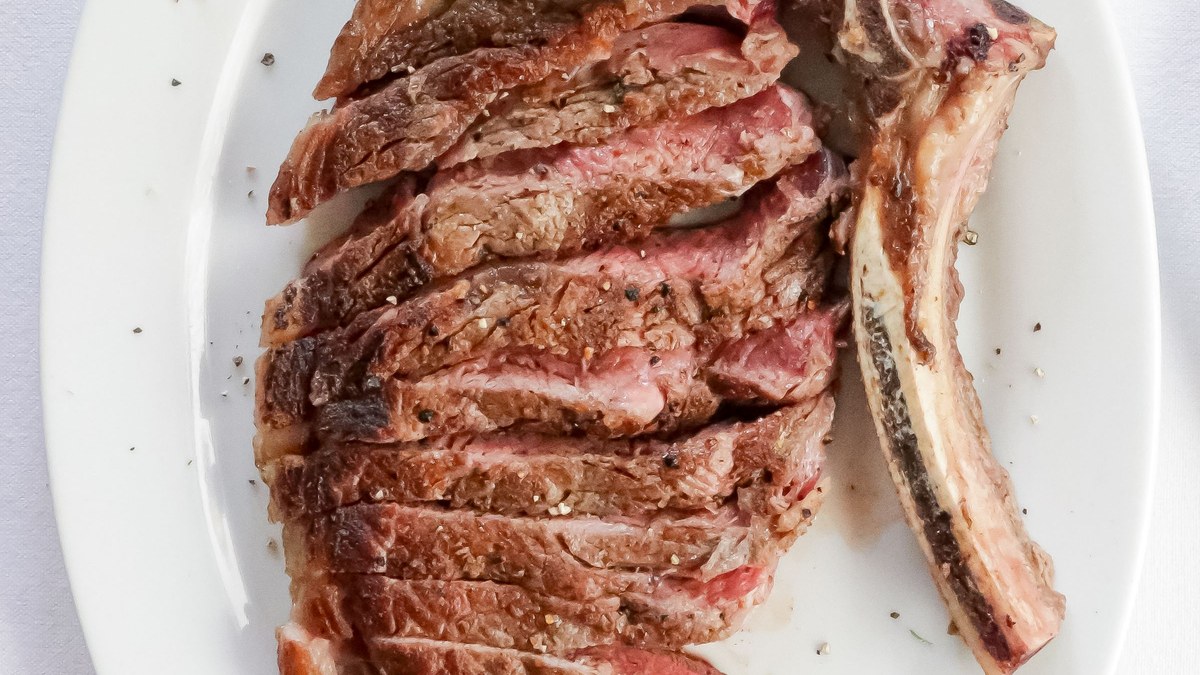
| Medium-rare | 125–130°F (52–54°C) | 130–135°F (54–57°C) | Warm red-pink center, soft with a little spring |
| Medium (USDA safe minimum) | 140°F (60°C) | 145°F (63°C), 3-minute rest | Pink center, springy |
| Medium-well | 145–150°F (63–66°C) | 150–155°F (66–68°C) | Thin line of light pink, firm |
| Well done | 155°F (68°C) | 160°F (71°C) and up | Brown throughout, very firm |
USDA FSIS lists 145°F with a 3-minute rest for whole cuts of beef. Rare and medium-rare sit below that line and are a personal choice many cooks make for whole steaks. If you're serving young children, older adults, pregnant guests or anyone with a weakened immune system, cook steak to at least 145°F.
For the full list of beef, pork, poultry and fish numbers, see the doneness temperatures chart. To estimate minutes per side from thickness and doneness, use the steak cooking time calculator.
How to take a steak's temperature
- Use an instant-read thermometer. A thin digital probe reads in a few seconds. Leaving a dial thermometer in a hot pan for 20 seconds lets the steak keep cooking while you wait.
- Go in from the side. Hold the steak with tongs and slide the probe in through the edge, so the tip reaches the middle of the thickest part. On a 1-inch steak, poking down from the top makes it easy to overshoot the center.
- Avoid bone and fat. On a T-bone, ribeye or porterhouse, stay at least half an inch from the bone. The fat cap and big seams of fat read differently from the meat.
- Read the lowest number. Ease the probe slightly in and out. The coolest spot is the true center.
- Check both sides on uneven cuts. A strip steak with a thin tail or a filet that tapers needs a reading in the thickest part.
Thickness and carryover cooking
When a steak comes off the heat, the outside is much hotter than the center. That heat keeps moving inward while the steak rests, so the center keeps climbing for a few minutes. This is carryover cooking, and it's why you pull a steak before it reaches your target.
- Thin steaks (½–¾ inch): rise about 2–3°F. Pull just a few degrees under your target, and check early, since they cook in a few minutes.
- 1 to 1½ inch steaks: rise about 3–5°F. This is where the chart above is most accurate.
- Thick steaks (2 inches and up): can rise 5–8°F, especially after a hot sear. Pull them a little lower, or use the reverse sear for even color edge to edge.
Large roasts carry over even more. A standing rib roast can rise 10°F or more, which is covered in our guide to prime rib internal temp.
Cut by cut
Ribeye and strip
Both have plenty of marbling, and many cooks like them at medium-rare to medium, since the fat softens more as it warms. A 1-inch ribeye in a hot cast-iron skillet usually takes about 3 to 5 minutes per side. The full stovetop method, with butter basting, is in how to cook steak on the stove.
Filet mignon
Filet is very lean and tender, so it shows doneness quickly. It's usually cut thick, 1½ to 2 inches, which makes a sear followed by a few minutes in a 400°F (205°C) oven a good approach. See how to cook filet mignon.
Sirloin, flank and skirt
These are leaner and chewier. They're best at medium-rare to medium and sliced thin against the grain. Skirt and flank are thin, so they cook in just a few minutes per side.
Thick-cut steaks
For steaks 1½ inches or thicker, the reverse sear gives the most even result: bake low at 250°F (120°C) until the center is about 10–15°F below your target, then sear hard in a skillet. Our guide on how to reverse sear steak walks through it.
Resting a steak
USDA's 145°F number includes a 3-minute rest, and that rest matters for flavor too. Resting lets the temperature even out from edge to center, and the juices settle back into the meat instead of running out on the board. Give a 1-inch steak 3 to 5 minutes and a thick steak 5 to 10 minutes on a board or a warm plate. Tenting loosely with foil is fine; wrapping tightly softens the crust.
How to tell when a steak is close
The thermometer gives you the exact answer, but these cues tell you when to check.
- Sight: a deep brown crust on both sides, and on thicker steaks, the gray band creeping up the edges. Beads of juice appearing on the top surface usually mean the center is getting close to medium-rare.
- Sound: a loud, steady sizzle at first that softens once the surface dries out and the crust forms.
- Smell: a rich, browned, nutty aroma. If the pan smells sharp and acrid, lower the heat.
- Touch: press the center with tongs. Rare is very soft, medium-rare gives with a slight bounce, medium is springy, and well done feels firm.
Touch tests take practice and vary by cut, so use them to decide when to probe, not instead of probing. Our guide on how to tell when food is done has more on reading these cues.
Leftover steak
Refrigerate leftover steak within 2 hours and eat it within 3 to 4 days. USDA says to reheat leftovers to 165°F (74°C). Thin slices warmed briefly in a hot skillet with a splash of broth stay tender. For gentle methods that keep the center from going gray, see how to reheat steak.
Making burgers instead? Ground beef follows a different rule, covered in burger internal temp. For slow-cooked beef, see brisket internal temp.
Internal temps for other meats
The same rule of thumb for everything else you cook: these are USDA safe minimums, with the pull point or texture target where it differs.
| Guide | Done at |
|---|---|
| Chicken internal temp | 165°F (74°C) Every cut, whole bird |
| Chicken breast internal temp | 165°F (74°C) Pull at 160–162°F, rest 5 min |
| Chicken thigh internal temp | 165°F (74°C) Most tender at 175–185°F |
| Turkey internal temp | 165°F (74°C) Breast, thigh and wing |
| Prime rib internal temp | 145°F (63°C) USDA Pull at 120°F for medium-rare |
| Brisket internal temp | 145°F (63°C) safe Tender at 195–205°F |
| Burger internal temp | 160°F (71°C) 165°F for turkey or chicken |
| Meatloaf internal temp | 160°F (71°C) 165°F for turkey or chicken |
| Pork internal temp | 145°F (63°C) Ground pork 160°F |
| Pork chop internal temp | 145°F (63°C) Pull thick chops near 140°F |
| Pork loin internal temp | 145°F (63°C) Pull roasts at 140°F |
| Pork tenderloin internal temp | 145°F (63°C) Pull at about 142°F |
| Salmon internal temp | 145°F (63°C) USDA Many cooks pull at 125–130°F |
No thermometer in the drawer? See how to tell if steak is done by touch and color, and why time per side alone is not enough.
Cooking outdoors? How to grill steak has times by thickness for gas and charcoal.
Cooking a thin cut? Here's what flank steak is and how to slice it so it's tender.
Cooking it in the air fryer? Our air fryer steak guide has times by thickness and doneness.
Pan watches it for you
Pan tells you when to check the steak
Pan can't read the inside of the steak, but it watches the pan. It sees the crust deepen, keeps the clock for each side, and tells you when to flip and when to grab the thermometer for your doneness.
- Pan shimmering and just starting to smoke: lay the steak in
- Dark brown crust on the first side: flip
- Even crust on both sides: check the center temperature
- Butter foaming and browning: tilt and baste
Pan AI is on iPhone • Android.
Common questions
What is the internal temp of steak for medium-rare?
Medium-rare steak finishes at about 130–135°F (54–57°C). Take it off the heat around 125–130°F and rest it; carryover cooking brings it up the last few degrees.
What temperature does USDA recommend for steak?
USDA FSIS lists 145°F (63°C) for whole cuts of beef, followed by a 3-minute rest. Lower doneness levels like rare and medium-rare are a personal choice below that safe minimum.
When should I pull a steak off the heat?
Pull it about 5°F (3°C) below your target. A thick steak or a roast can rise 5–10°F while resting; a thin steak rises only 2–3°F.
How long should steak rest?
Rest steaks at least 3 minutes, and 5–10 minutes for thick cuts. Resting lets the temperature even out and keeps juices on the steak instead of the board.
Where do you put the thermometer in a steak?
Insert it from the side into the thickest part, so the tip sits in the very center. Avoid the bone and the fat cap, which can read differently from the meat.
Is ground beef the same temperature as steak?
No. Ground beef needs 160°F (71°C) because grinding spreads surface bacteria through the meat. Whole steaks are safe at 145°F with a 3-minute rest.
What is the internal temp of steak in Celsius?
Rare: pull at 46–49°C. Medium rare: pull at 52–54°C for 54–57°C after resting. Medium: pull at 60°C for 63°C. Well done: 71°C and up.
What is the internal temp of a well done steak?
Pull it at 155°F (68°C); it rests up to 160°F (71°C) or more and is brown throughout.
What is the internal temp of a rare steak?
Pull it at 115–120°F (46–49°C) for 120–125°F after resting: a cool to warm red center.
What is the internal temp of flank steak?
The same chart applies: pull at 125–130°F for medium rare, which suits flank best. Slice it thinly across the grain.
What temperature should a pork steak be?
Pork steaks are done at 145°F (63°C) with a 3-minute rest, like pork chops. Shoulder pork steaks get more tender if you take them higher, to about 160–170°F.
What is the internal temp of tuna steak?
Many cooks sear tuna steak and serve it rare, about 115–125°F in the center. The FDA guideline for fish is 145°F (63°C), when it is opaque all the way through.
Sources
- USDA FSIS: Safe Minimum Internal Temperature Chart
- FoodSafety.gov: Safe Minimum Internal Temperatures
- USDA FSIS: Beef from Farm to Table
Reviewed against USDA FSIS and FoodSafety.gov guidance. How we choose sources and fix mistakes: editorial policy.
Keep cooking
- Meat & poultryHow to Cook Steak on the StoveCook steak on the stove in a hot cast iron pan: 3–4 minutes per side for a 1-inch medium-rare steak, then rest 5 minutes. Timing chart and doneness cues.
- Thanksgiving & holidaysHow to Reverse Sear SteakReverse sear a ribeye: bake at 250°F until 10 to 15°F below your target, then sear 1 minute per side in a very hot skillet. Times, pull temps and cues inside.
- Meat & poultryHow to Cook Filet MignonSear filet mignon 2–3 minutes per side in a hot skillet, then roast at 400°F for 4–8 minutes and pull at 125°F for medium-rare. Butter baste and temp chart.
- Thanksgiving & holidaysPrime Rib Internal TempPull prime rib at 120°F (49°C) for medium-rare; a 20–30 minute rest carries it about 10°F higher, to 130°F. Pull and final temps from rare to well done.
- Start hereChatGPT for Cooking vs Pan AI: What Changes on December 11, 2026ChatGPT voice changes on Dec 11, 2026, and Live has no video. An honest ChatGPT cooking alternative that watches your pan, and where ChatGPT still wins.
- Start herePan AI vs Samsung FoodSamsung Food saves recipes, plans meals and builds shopping lists. Pan AI watches your pan and tells you when to flip. Where each one is better, side by side.
- Free toolSteak cooking time calculatorMinutes per side by thickness and doneness, pan, grill or reverse sear, with pull temps.
- Free toolInternal temperature chartSafe and perfect internal temperatures for steak, chicken, salmon, pork and more, plus a printable PDF.