Brisket Internal Temp
Quick answer
Brisket internal temp is 145°F (63°C) for safety, USDA's minimum for whole cuts of beef, but brisket is still tough there. It turns tender at 195–205°F (91–96°C) in the thickest part of the flat, once the connective tissue breaks down. Most cooks aim for about 203°F and check by feel: the probe should slide in like butter. Rest it wrapped at least 1 hour.
Handy for this: Internal temperature chart · Reheating guide
Part of our Food safety temperatures (safe temperatures, storage times and thawing in one chart) hub.
At a glance
- Cook the brisket low and slow, at 225–275°F (107–135°C) in a smoker or about 300°F (150°C) in the oven.
- Expect the internal temperature to stall somewhere around 150–170°F (66–77°C).
- Wrap in butcher paper or foil once the bark is set and the color looks right, if you want to push through the stall faster.
- Start checking the thickest part of the flat at about 195°F (91°C).
- When a probe slides in with almost no resistance, usually 198–205°F, take it off the heat.
- Rest the brisket wrapped for at least 1 hour, then slice against the grain.
The short version
Brisket is safe to eat at 145°F (63°C) with a 3-minute rest, which is USDA's safe minimum internal temperature for whole cuts of beef. But a brisket at 145°F is firm and chewy. It turns tender, sliceable and juicy at about 195–205°F (91–96°C) in the thickest part of the flat. Most cooks aim close to 203°F and confirm by feel: a probe should slide in with almost no resistance.
So there are really two brisket numbers. 145°F is about safety. 195–205°F is about texture, and that's the one that decides when brisket is done.
“Brisket slices are warming in the broth and just starting to steam. Give them another minute, then check for 165°F.”
Brisket temperature chart
| Stage | Internal temp | What's happening |
|---|---|---|
| Safe minimum | 145°F (63°C), 3-minute rest | Safe to eat, but tough and chewy |
| The stall | About 150–170°F (66–77°C) | Temperature sits still for hours while surface moisture evaporates |
| Common wrap point | About 160–170°F (71–77°C) | Bark is set; wrapping pushes through the stall |
| Sliceable | About 195–198°F (91–92°C) | Holds together in neat slices, still has some chew |
| Probe-tender (most cooks' target) | About 200–205°F (93–96°C) | Collagen has melted; slices bend and pull apart easily |
| Holding while resting | Above 140°F (60°C) | Keep it in this range for long holds |
| Reheating leftovers | 165°F (74°C) | USDA guidance for all leftovers |
For every other cut of beef, pork and poultry, the doneness temperatures chart has the full list.
Why brisket needs such a high number
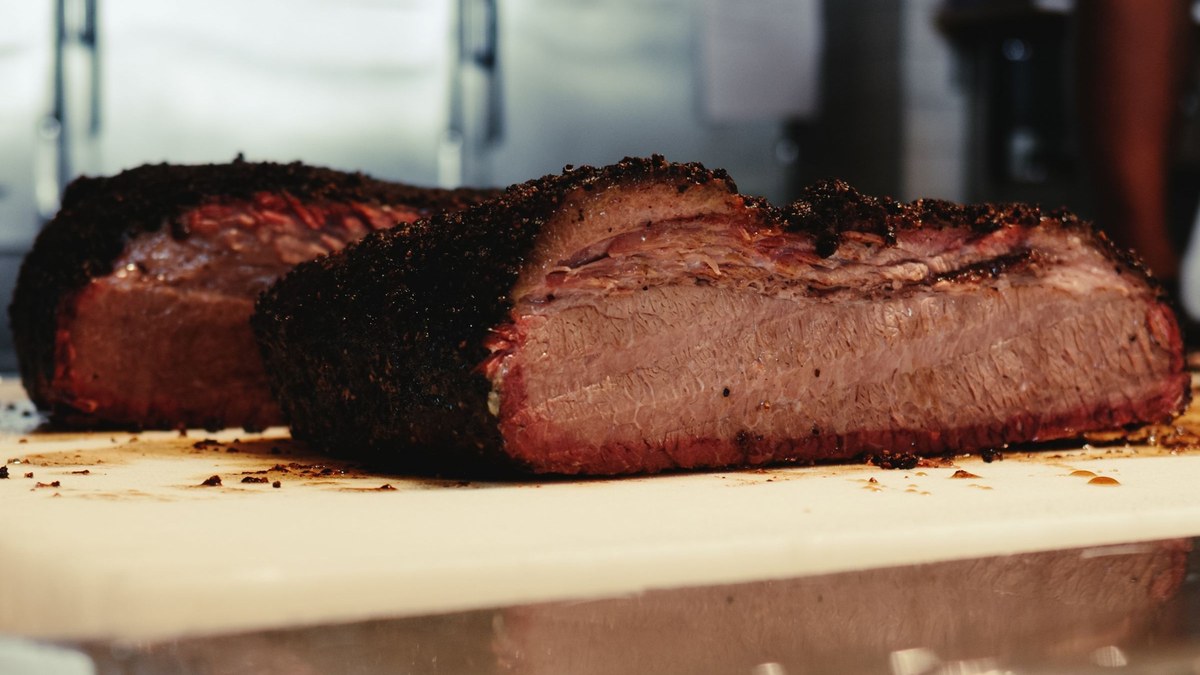
Brisket comes from the chest of the cow, a hard-working muscle full of collagen, the connective tissue that holds muscle fibers together. At 145°F, all that collagen is still intact, so the meat is tough. Held for hours between roughly 160°F and 205°F, collagen slowly melts into gelatin. That's what gives good brisket its moist, almost silky bite.
This is the opposite of a steak. Tender cuts like ribeye or filet have little collagen, so cooking them past medium only dries them out, as covered in steak internal temp. Tough cuts like brisket, pork shoulder and chuck roast need long, slow heat. The same idea applies to pulled pork in our pork internal temp guide and to pot roast.
The stall
Somewhere around 150–170°F, a brisket's temperature stops climbing. It can sit within a few degrees for 2 to 6 hours. This is the stall, and it catches almost everyone off guard the first time.
It happens because moisture is evaporating from the surface of the meat, and that evaporation cools the brisket about as fast as the smoker warms it, much like sweat cools skin. Once enough surface moisture is gone, the temperature starts rising again.
You have two choices:
- Ride it out. Leave the brisket unwrapped. It takes longer, but the bark ends up firmer and crustier.
- Wrap it. Once the bark is set and deep mahogany, wrap the brisket tightly in butcher paper or foil. Wrapping traps moisture so evaporation slows, and the temperature climbs again sooner. Foil is fastest but softens the bark more; butcher paper is a middle ground.
Don't turn the heat way up to escape the stall. Patience is part of the recipe.
How to check brisket's temperature
- Probe the flat. A whole packer brisket has two muscles: the thin, lean flat and the thicker, fattier point. The flat is the one most likely to be under-done, so check its thickest part.
- Go in from the side. Slide the probe in horizontally so the tip sits in the center of the meat, not in the fat layer between the two muscles.
- Use a leave-in probe for the long stretch. A wired probe lets you watch the stall without opening the lid. Switch to an instant-read thermometer near the end to check several spots.
- Check more than one spot. Brisket is uneven. Test the flat in two or three places and the point once.
Probe-tender: the real test
Two briskets can be perfectly tender at different temperatures, since fat, thickness and grade all vary. That's why experienced cooks use feel to make the final call. Starting around 195°F, push your thermometer probe or a thin skewer into the flat. When it slides in like it's going into soft butter, with almost no resistance anywhere you test, the brisket is ready. If you feel tightness in some spots, give it another 30 to 60 minutes and check again.
A second cue: pick up the wrapped brisket in the middle with gloved hands. A tender brisket droops and jiggles. A stiff one needs more time.
Smoker and oven times
| Method | Cooking temp | Rough time |
|---|---|---|
| Smoker, low | 225°F (107°C) | About 1¼–1½ hours per pound |
| Smoker, medium | 250–275°F (121–135°C) | About 1–1¼ hours per pound |
| Oven, wrapped or covered | 300°F (150°C) | About 1 hour per pound |
These are planning numbers, not promises. A 12-pound packer at 250°F might take 10 hours, or 14. Start early, and remember a wrapped brisket holds well in a cooler, so finishing ahead of time is easy to handle.
Oven brisket
The oven works well, especially for a flat. Season generously, sear or roast uncovered at 300°F for the first 2 hours to build color, then wrap tightly in foil or cover the pan with a splash of broth and keep cooking until probe-tender. You won't get a smoke ring, but you'll get the same tender texture.
Resting brisket
Resting matters more for brisket than almost any other cut. It lets the temperature even out and the juices thicken back into the meat. Rest a brisket at least 1 hour, wrapped. For a longer hold, wrap it in a towel and set it in a dry cooler; it can stay hot for 2 to 4 hours. Keep the internal temperature above 140°F (60°C) during a long hold.
Slice the flat against the grain into pencil-thick slices. The grain runs a different direction in the point, so turn it before slicing, or chop the point for sandwiches.
Leftover brisket
Refrigerate leftover brisket within 2 hours and eat it within 3 to 4 days, or freeze it. Reheat to 165°F (74°C). Slices warmed in a covered skillet with a splash of beef broth over medium-low stay moist, and this is the one brisket step Pan can help with, since it's on the stove. The reheating guide has times for each method.
Planning a beef roast instead? See prime rib internal temp. For a weeknight ground-beef dinner, see meatloaf internal temp.
Internal temps for other meats
The same rule of thumb for everything else you cook: these are USDA safe minimums, with the pull point or texture target where it differs.
| Guide | Done at |
|---|---|
| Chicken internal temp | 165°F (74°C) Every cut, whole bird |
| Chicken breast internal temp | 165°F (74°C) Pull at 160–162°F, rest 5 min |
| Chicken thigh internal temp | 165°F (74°C) Most tender at 175–185°F |
| Turkey internal temp | 165°F (74°C) Breast, thigh and wing |
| Steak internal temp | 145°F (63°C) USDA Medium-rare 130–135°F |
| Prime rib internal temp | 145°F (63°C) USDA Pull at 120°F for medium-rare |
| Burger internal temp | 160°F (71°C) 165°F for turkey or chicken |
| Meatloaf internal temp | 160°F (71°C) 165°F for turkey or chicken |
| Pork internal temp | 145°F (63°C) Ground pork 160°F |
| Pork chop internal temp | 145°F (63°C) Pull thick chops near 140°F |
| Pork loin internal temp | 145°F (63°C) Pull roasts at 140°F |
| Pork tenderloin internal temp | 145°F (63°C) Pull at about 142°F |
| Salmon internal temp | 145°F (63°C) USDA Many cooks pull at 125–130°F |
New to brisket? Here's what brisket is, point vs flat, and a classic smoked recipe.
Pan watches it for you
Pan helps with brisket leftovers
Brisket lives in the smoker or oven, where Pan can't see it. Where it helps is the next day: warming sliced or chopped brisket in a skillet, watching for steam and simmering broth, and reminding you to check for 165°F.
- Broth just simmering around the slices: cover and lower the heat
- Steam rising steadily under the lid: check the thickest slice
- Edges of chopped brisket crisping: stir
- Liquid nearly gone: add a splash of broth
Pan AI is on iPhone • Android.
Common questions
What is the internal temp of brisket when done?
Brisket is safe at 145°F (63°C), but it's done for slicing or shredding at about 195–205°F (91–96°C). Many cooks aim for around 203°F and confirm it's probe-tender.
Why does brisket stall?
Around 150–170°F (66–77°C), moisture evaporating from the surface cools the meat about as fast as the heat warms it. The temperature can sit flat for hours. It passes on its own, or faster if you wrap the brisket.
When should I wrap a brisket?
Many cooks wrap once the bark is firm and deep mahogany, usually somewhere in the stall around 160–170°F. Butcher paper keeps more bark texture; foil speeds things up more.
What does probe-tender mean?
It means a thermometer probe or skewer slides into the thickest part of the flat like it's going into soft butter. That feel is a better signal than any single number.
How long should brisket rest?
Rest at least 1 hour, wrapped, and up to 2–4 hours in an insulated cooler. Keep it above 140°F (60°C) if it's resting a long time.
Can you cook brisket in the oven?
Yes. Cook it covered or wrapped at about 300°F (150°C) until probe-tender at 195–205°F. Plan roughly 1 hour per pound, then rest.
What is the internal temp of corned beef brisket?
Corned beef brisket is safe at 145°F, but it is cooked to about 190–205°F so it turns fork-tender and slices without being chewy.
What internal temp should brisket be before wrapping?
Most cooks wrap at about 160–170°F, once the bark is firm and deep mahogany, which is usually during the stall.
What temperature should I smoke brisket at?
225–275°F (107–135°C). At 225°F plan about 1¼–1½ hours per pound; at 250–275°F about 1–1¼ hours per pound, until it is probe-tender at 200–205°F.
What is the internal temp of brisket in the oven?
The same as smoked: probe-tender at about 200–205°F (93–96°C). In a 300°F oven, wrapped or covered, it takes about 1 hour per pound.
What temp do you pull brisket?
Most cooks pull it at about 200–205°F (93–96°C), when a probe slides into the thickest part of the flat like soft butter. At 195–198°F it slices neatly but still has some chew.
Where do you temp a brisket?
In the thickest part of the flat. Start checking there at about 195°F (91°C).
How long does brisket take at 225°F?
About 1¼–1½ hours per pound in the smoker. At 250–275°F it takes about 1–1¼ hours per pound, and wrapped in a 300°F oven about 1 hour per pound.
Sources
- USDA FSIS: Safe Minimum Internal Temperature Chart
- USDA FSIS: Beef from Farm to Table
- USDA FSIS: Leftovers and Food Safety
Reviewed against USDA FSIS guidance. How we choose sources and fix mistakes: editorial policy.
Keep cooking
- Soups & stewsHow to Make Pot RoastBraise a 3–4 lb chuck roast covered at 300–325°F for 3–4 hours, until it shreds with a fork at about 195–205°F. Sear first and add carrots near the end.
- Meat & poultryPork Internal TempCook pork chops, loin and tenderloin to 145°F (63°C) with a 3-minute rest, ground pork to 160°F (71°C), and pulled pork shoulder to 195–205°F for tenderness.
- Start hereSteak Internal TempMedium-rare steak finishes at 130–135°F (54–57°C); USDA's safe minimum is 145°F (63°C) with a 3-minute rest. Pull temps, final temps and carryover.
- Thanksgiving & holidaysPrime Rib Internal TempPull prime rib at 120°F (49°C) for medium-rare; a 20–30 minute rest carries it about 10°F higher, to 130°F. Pull and final temps from rare to well done.
- Start hereChatGPT for Cooking vs Pan AI: What Changes on December 11, 2026ChatGPT voice changes on Dec 11, 2026, and Live has no video. An honest ChatGPT cooking alternative that watches your pan, and where ChatGPT still wins.
- Start herePan AI vs Samsung FoodSamsung Food saves recipes, plans meals and builds shopping lists. Pan AI watches your pan and tells you when to flip. Where each one is better, side by side.
- Free toolInternal temperature chartSafe and perfect internal temperatures for steak, chicken, salmon, pork and more, plus a printable PDF.
- Free toolReheating guideHow to reheat fried chicken, steak, prime rib, rice and 20+ leftovers so they taste fresh.