How to Tell When Food Is Done
Quick answer
Use an instant-read thermometer for meat and fish: chicken is done at 165°F, ground meat and fresh chorizo at 160°F, steaks, pork chops and fish at 145°F. For everything else, use cues: pasta is tender with a thin firm core, rice has absorbed all its water, cheesecake jiggles only in the center (about 150°F), and pecan pie is set with a gentle wobble (185 to 200°F).
Part of our Food safety temperatures (safe temperatures, storage times and thawing in one chart) hub.
Handy for this: Internal temperature chart · Boiled egg timer
The short answer
For meat, poultry and fish, an instant-read thermometer is the one sure test. For pasta, rice, vegetables, eggs and baked goods, your eyes, ears, nose and a quick touch tell you everything you need.
The best cooks combine both. The thermometer confirms, and the senses tell you when to reach for it. Here is every cue, food by food.
“Edges are opaque and the center just turned from glossy to matte. Thirty more seconds and it's done.”
Doneness chart: temperatures and cues
| Food | Done temperature | What you'll see and feel |
|---|---|---|
| Chicken and turkey (all cuts) | 165°F (74°C) safe; thighs best at 175°F+ | Opaque white through, juices clear, firm with a little spring |
| Ground beef, pork, lamb | 160°F (71°C) | Brown throughout, juices clear, no pink sheen |
| Fresh Mexican chorizo | 160°F (71°C) | Firm, crumbly, orange fat rendered out |
| Steaks and roasts (beef, lamb) | 145°F (63°C) + 3 min rest safe; 130 to 135°F medium-rare by preference | Golden crust, springy center, juices pool on the surface |
| Pork chops and tenderloin | 145°F (63°C) + 3 min rest | Faint blush of pink, juices clear |
| Fish | 145°F (63°C) | Opaque, flakes easily with a fork |
| Shrimp and scallops | 145°F (63°C) | Shrimp pink and C-shaped; scallops opaque and springy |
| Egg dishes (frittata, quiche, scrambled) | 160°F (71°C) | No liquid egg visible, center set |
| Fried and boiled eggs | Whites and yolks firm for full safety | Whites fully set and opaque |
| Leftovers and casseroles | 165°F (74°C) | Steaming hot in the center |
| Cheesecake | 145 to 150°F (63 to 66°C) | Edges set, center 2 to 3 inches jiggles |
| Pecan pie | 185 to 200°F (85 to 93°C) | Edges puffed, center wobbles as one piece |
| Cakes and cupcakes | 200 to 209°F (93 to 98°C) | Springs back, toothpick has a few moist crumbs |
| Lean bread (sourdough, baguette) | 190 to 210°F (88 to 99°C) | Deep golden crust, hollow thump underneath |
Our doneness temperatures chart goes deeper, with every steak doneness level and roast.
When is chicken done?
Chicken is done when the thickest part reaches 165°F, the USDA safe minimum for all poultry. Insert the thermometer sideways into the thickest point of a breast, or into the thickest part of a thigh at least 1/4 inch from the bone.
- Sight: the meat is opaque white all the way through, with clear juices. The outside is golden.
- Touch: it feels firm with a gentle spring, like pressing the base of your thumb.
- Sound: in a skillet, the sizzle mellows as moisture cooks off the surface.
Breasts are juiciest pulled right at 160 to 165°F; see how to cook chicken breast on the stove. Thighs are more forgiving and become tender at 175°F and above, as in our pan fried chicken thighs. Every chicken cue, with a chart by cut, is in how to tell if chicken is done.
Steak, pork and burgers
Whole cuts of beef, pork and lamb are safe at 145°F with a 3-minute rest. Many people enjoy steak cooked less, at 130 to 135°F for medium-rare. Ground meat is different: grinding mixes surface bacteria throughout, so burgers go to 160°F.
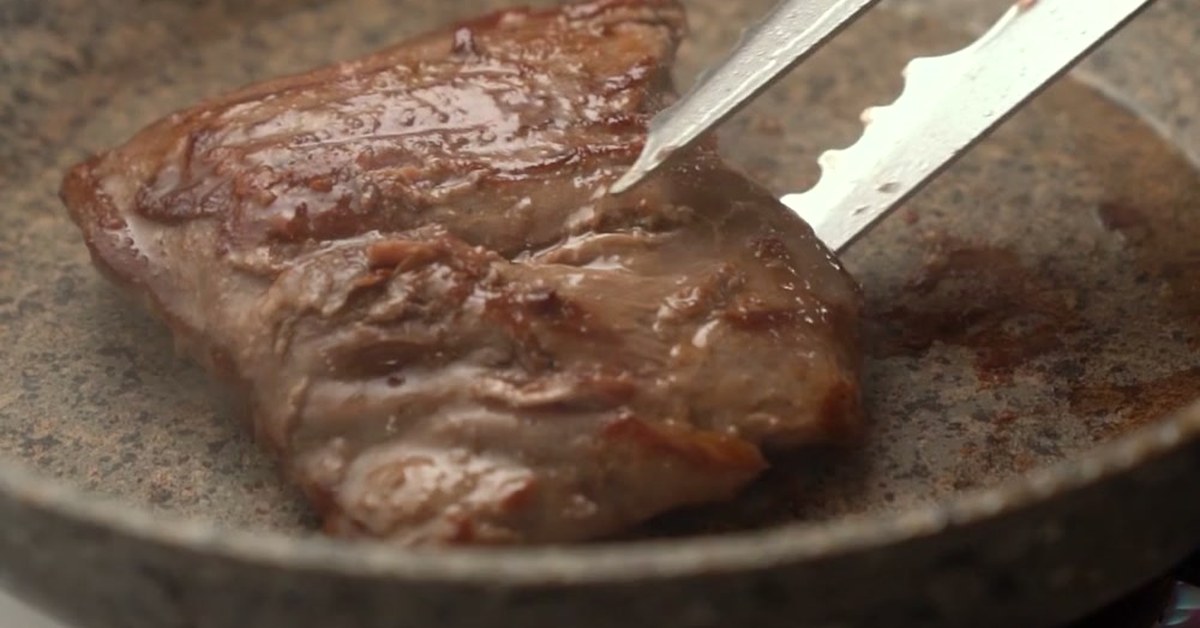
- Sight: a deep golden-brown crust, and juices beading on the top surface of a steak when it is nearly ready to flip.
- Touch: rare feels soft, medium-rare springy, medium firm with some give.
- Thermometer: pull steaks about 5°F below your target, since the temperature keeps rising while it rests.
Step-by-step guides: how to cook a steak on the stove, how to cook pork chops on the stove and how to cook burgers on the stove. Not sure when to turn it? See when to flip steak.
How to tell when chorizo is done
First check which chorizo you have. Mexican chorizo is fresh, raw ground pork sausage, usually sold soft in a casing or tube. Spanish chorizo is firm, cured and ready to eat, so you only warm it.
Cook Mexican chorizo to 160°F, like any ground pork. Because paprika and chiles keep it deep red even when cooked, color is not your guide. Instead, look for these cues:
- It breaks into firm, separate crumbles instead of a soft, sticky paste.
- Bright orange fat has rendered into the pan.
- Edges of the crumbles turn crisp and darker, usually after 6 to 8 minutes over medium heat.
- A thermometer in a pile of crumbles or a link reads 160°F.
Fish and seafood
Fish is done at 145°F, or when the flesh turns opaque and separates easily into flakes with a fork. Salmon is the exception many people prefer slightly lower, but 145°F is the USDA safe minimum.
- Sight: watch the opaque color creep up the sides from the pan. When it is about two-thirds of the way up, flip.
- Touch: fish releases from the pan when its crust is ready.
- Shrimp: pink and opaque, curled into a loose C. A tight O means it went a little long.
More detail: salmon internal temp, how to cook salmon on the stove, pan fried fish and how to pan sear scallops.
Eggs
For fried and boiled eggs, the safest choice is whites and yolks that are firm. Egg dishes like frittatas and quiche are done at 160°F, when the center is set and no liquid egg runs.
- Fried eggs: the white turns from clear to fully opaque white, and the edges get lacy. See how to make a fried egg sunny side up.
- Boiled eggs: timing is everything since you cannot see inside. Use our egg timer for soft, jammy or hard-boiled, and how long to boil eggs for the full chart.
- Scrambled: soft curds with no glossy liquid egg left.
Pasta, rice and grains
- Pasta: start tasting 2 minutes before the package time. Al dente pasta is tender with a slight bite at the core. Cut a piece: a thin pale dot in the center is perfect al dente.
- Rice: all the water is absorbed and small steam holes dot the surface. Tilt the pot slightly; no water should pool. Then rest it covered for 10 minutes. See how to cook jasmine rice on the stove.
- Quinoa and lentils: quinoa shows a little white spiral tail around each seed; lentils are tender but still hold their shape. See lentils and quinoa on the stove.
Vegetables
Vegetables do not need a thermometer. They are done when they reach the texture you like:
- Tender-crisp: bright in color, and a knife meets slight resistance in the center.
- Fully tender: a fork slides through with no resistance, as for mashed potatoes.
- Browned: golden spots on the flat sides and a sweet, nutty smell.
Times for each vegetable are in how to cook vegetables on the stove and our boiling times chart.
How to tell when cheesecake is done
Cheesecake is a custard, so it is done before it looks firm. Gently nudge the side of the pan:
- The outer 2 to 3 inches are set, matte and slightly puffed.
- The center 2 to 3 inches still jiggle as one piece, like gelatin, without looking liquid.
- Thermometer: about 145 to 150°F in the center. ThermoWorks suggests pulling around 145°F, and America's Test Kitchen uses 150°F.
The center finishes setting as the cheesecake cools and chills overnight. A smooth top with no deep browning is the sign of a beautifully gentle bake.
How to tell if pecan pie is done
Pecan pie can look done before the filling has fully set, so use two checks:
- The wobble test: nudge the pie. Done filling wobbles slightly as a whole in the very center, like gelatin. Filling that ripples in waves needs more time.
- The thermometer: 185 to 200°F in the center of the filling. America's Test Kitchen aims for 185°F; ThermoWorks recommends 200°F.
- Sight: the edges are puffed and set, and the pecans on top are toasted golden. If the crust edge is browning faster than the filling sets, cover it loosely with foil.
Pecan pie also firms up as it cools, so let it rest at least 2 hours before slicing.
Other baked goods
- Cakes: the top springs back when pressed lightly, the edges pull away from the pan, and a toothpick comes out with a few moist crumbs. Internal 200 to 209°F.
- Bread: deep golden crust and a hollow sound when you tap the bottom. Lean breads read 190 to 210°F; enriched breads like brioche 180 to 190°F.
- Cookies: edges golden and set, centers still soft. They firm up on the sheet.
Tips for reading doneness like a pro
- Buy an instant-read thermometer. It is the most useful tool under $30 in any kitchen.
- Check the thickest part, and avoid bone, fat and the pan surface.
- Plan for carryover. Large cuts rise 5 to 10°F as they rest; pull them a little early.
- Start checking early. Ovens and stoves vary, so check at the low end of any time range.
- Use more than one sense. Sight tells you when to check, and the thermometer confirms.
- Start with a hot enough pan. A quiet pan cooks slowly and unevenly; here's how to tell if oil is hot enough.
Reading these cues in real time is what Pan AI is built for: it watches your pan through your phone camera and tells you, out loud, what it sees, like when it's time to flip. The thermometer is still the final word. If you are just getting started, our cooking for beginners guide puts all of this into a simple first-week plan.
Common questions
How do you know when chicken is done?
The thickest part reads 165°F on an instant-read thermometer, the USDA safe minimum for all poultry. The juices run clear and the meat is opaque and white through the center. Thighs are even more tender at 175°F.
How do you tell when chorizo is done?
Fresh Mexican chorizo is raw ground pork, so cook it to 160°F. Because paprika and chiles keep it red, color is not a reliable cue: look for firm, crumbly pieces with no glossy raw texture and plenty of rendered orange fat. Spanish chorizo is cured and only needs to be warmed.
How do you know when cheesecake is done?
The outer 2 to 3 inches look set and slightly puffed, while the center 2 to 3 inches still jiggle like gelatin when you nudge the pan. An instant-read thermometer in the center reads about 150°F. It firms fully as it cools and chills.
How can you tell if pecan pie is done?
The edges are set and puffed, and the center wobbles slightly as a whole, like gelatin, rather than sloshing in waves. The filling reads 185 to 200°F in the center. Start checking 10 minutes before the recipe's time.
Is clear juice enough to tell chicken is done?
It is a helpful hint, but not a guarantee. Juice color can vary, so the USDA recommends a food thermometer as the only reliable way to confirm 165°F.
How do you tell when fish is done without a thermometer?
Press the thickest part with a fork. Done fish turns from translucent to opaque and separates into flakes easily. The USDA safe minimum for fish is 145°F.
Sources
- USDA FSIS: Safe Minimum Internal Temperature Chart
- FoodSafety.gov: Safe Minimum Internal Temperatures
- ThermoWorks: Doneness Temperatures for Baked Goods
- Cook's Illustrated: Knowing When Pies, Pastries and Cheesecakes Are Done
Reviewed against USDA FSIS and FoodSafety.gov guidance. How we choose sources and fix mistakes: editorial policy.
Keep cooking
- Meat & poultryHow to Cook Chicken Breast on the StoveCook a ¾-inch chicken breast on the stove 5–6 minutes per side over medium-high, then medium, until it reads 165°F. Times by thickness and doneness cues.
- Fish & seafoodHow to Cook Salmon on the StovePan-sear salmon skin side down over medium-high heat for 4–6 minutes, flip, and cook 2–3 minutes more. Timing by thickness and how to tell salmon is done.
- Meat & poultryHow to Cook Steak on the StoveCook steak on the stove in a hot cast iron pan: 3–4 minutes per side for a 1-inch medium-rare steak, then rest 5 minutes. Timing chart and doneness cues.
- Start hereCooking for Beginners: Everything You Need to StartLearn how to cook as a beginner: the 8 tools you need, 10 core techniques, safe temperatures, and a 7-day plan that builds real skills one meal at a time.
- Start hereChatGPT for Cooking vs Pan AI: What Changes on December 11, 2026ChatGPT voice changes on Dec 11, 2026, and Live has no video. An honest ChatGPT cooking alternative that watches your pan, and where ChatGPT still wins.
- Start herePan AI vs Samsung FoodSamsung Food saves recipes, plans meals and builds shopping lists. Pan AI watches your pan and tells you when to flip. Where each one is better, side by side.
- Free toolInternal temperature chartSafe and perfect internal temperatures for steak, chicken, salmon, pork and more, plus a printable PDF.
- Free toolBoiled egg timerSoft, jammy or hard: exact minutes for your egg size, with a built-in timer.