How to Make Pot Roast
Quick answer
Season a 3–4 lb (1.4–1.8 kg) chuck roast and sear it in a Dutch oven 4–5 minutes per side. Soften onions and garlic, add broth so the liquid comes halfway up the meat, cover and braise at 300–325°F (150–165°C) for 3–4 hours. Add potatoes and carrots for the last 1–1½ hours. It's ready when a fork twists easily into the meat.
Handy for this: Internal temperature chart · Reheating guide
At a glance
- Pat a 3–4 lb chuck roast dry, season it generously and let it sit while the oven heats to 300–325°F (150–165°C).
- Sear the roast in hot oil in a Dutch oven, 4–5 minutes per side, until deeply browned.
- Cook the onion, garlic and tomato paste in the same pot, then deglaze with wine or broth.
- Return the roast, add broth until it comes halfway up the meat, add herbs and cover.
- Braise 3–4 hours, adding potatoes and carrots for the last 1–1½ hours.
- When a fork twists into the meat easily (about 195–205°F), rest 10–15 minutes and serve with the juices.
The short version
Pot roast is mostly waiting, and that's the charm of it. Season a 3–4 lb (1.4–1.8 kg) chuck roast, brown it well in a Dutch oven, and add onions, garlic, tomato paste and enough broth to come halfway up the meat. Cover it and let it braise at 300–325°F (150–165°C) for 3–4 hours. Potatoes and carrots go in for the last hour or so.
It's ready when a fork slides into the meat and twists with no resistance. That usually happens around 195–205°F (90–96°C), well above the temperature where beef is safe, because that's when the tough connective tissue finally melts.
What you need
- A boneless chuck roast, 3–4 lb (1.4–1.8 kg). Look for one with lots of white marbling. Chuck eye, shoulder roast and 7-bone roast all work.
- Seasoning. 2 teaspoons kosher salt and 1 teaspoon black pepper.
- 2 tablespoons of oil for searing.
- Aromatics. 1 large yellow onion in wedges, 4 smashed garlic cloves and 2 tablespoons of tomato paste.
- Liquid. 1 cup (240 ml) dry red wine (or more broth), 2 cups (475 ml) low-sodium beef broth and 1 tablespoon Worcestershire sauce.
- Herbs. 2 bay leaves and 3–4 sprigs of thyme.
- Vegetables. 1½ lb (680 g) Yukon Gold potatoes, halved, and 1 lb (450 g) carrots in 2-inch pieces.
- A 5–6 quart Dutch oven with a tight lid. Enameled or bare cast iron holds steady heat for hours.
How to make pot roast in the oven, step by step
- Season early. Pat the roast dry and season it all over with the salt and pepper. Let it sit on the counter while the oven heats to 300–325°F (150–165°C), with a rack in the lower third.
- Sear hard. Heat the oil in the Dutch oven over medium-high until it shimmers. Lay in the roast and leave it alone for 4–5 minutes, until a dark brown crust forms and it lets go of the pot on its own. Turn and brown the other side, then the edges. Move it to a plate.
- Cook the aromatics. Lower the heat to medium. Add the onion and cook 3–4 minutes, stirring, until it softens and picks up color. Add the garlic and tomato paste and stir for 1–2 minutes, until the paste darkens to a brick red.
- Deglaze. Pour in the wine and scrape up every brown bit from the bottom with a wooden spoon. Simmer 2 minutes.
- Build the braise. Return the roast and any juices. Add the broth, Worcestershire, bay leaves and thyme. The liquid should come about halfway up the side of the meat. Bring it to a gentle simmer.
- Braise. Cover and move the pot to the oven. Cook for 2 hours, turning the roast once halfway through.
- Add the vegetables. Nestle the potatoes and carrots around the roast, pushing them down into the liquid. Cover and braise another 1–1½ hours.
- Test with a fork. Push a fork into the thickest part and twist. If it resists, cover and check again in 30 minutes.
- Rest and serve. Let the roast sit in the pot, uncovered, for 10–15 minutes. Skim the fat off the liquid, pull out the bay leaves and thyme stems, then break the meat into big chunks and spoon the juices over the top.
Want thicker gravy? Simmer the strained liquid on the stove with a cornstarch slurry, or use the method in our guide on how to make gravy.
Pot roast cooking times and temperatures
Times are for a boneless chuck roast, covered, with liquid halfway up the meat. Shape matters as much as weight: a thick, round roast takes longer than a flat one.
| Roast size | Oven temp | Approx. braising time | Fork-tender temp | Add vegetables |
|---|---|---|---|---|
| 2–3 lb (0.9–1.4 kg) | 325°F (165°C) | 2½–3 hr | 195–205°F (90–96°C) | Last 1 hr |
| 3–4 lb (1.4–1.8 kg) | 325°F (165°C) | 3–3½ hr | 195–205°F (90–96°C) | Last 1–1¼ hr |
| 3–4 lb (1.4–1.8 kg) | 300°F (150°C) | 3½–4 hr | 195–205°F (90–96°C) | Last 1¼–1½ hr |
| 4–5 lb (1.8–2.3 kg) | 300°F (150°C) | 4–4½ hr | 195–205°F (90–96°C) | Last 1½ hr |
| Slow cooker, 3–4 lb | Low | 8–10 hr | 195–205°F (90–96°C) | From the start |
For steaks, roasts and everything cooked to a pink center, the doneness temperature chart has the right numbers.
“The fork twists into the roast with no resistance and it reads about 200°F. It's ready, take the pot out and let it rest.”
How to tell when pot roast is done
Pot roast is the rare dish where a thermometer only tells half the story. Tenderness is the real test.
Sight
- During the sear, the surface goes from wet and red to gray, then to a deep, dark brown crust. That crust is flavor, so give it the full 4–5 minutes.
- Near the end, the meat looks slack and starts to separate along its natural seams. The fat lines look soft and translucent instead of white and firm.
- The braising liquid turns glossy and deep brown, and it has reduced by about a third.
Sound
- A loud sizzle when the roast hits the oil means the pot is hot enough. A quiet hiss means wait a minute longer.
- When you open the oven, you want a soft, lazy bubble. A hard rolling boil means the oven is a little hot; drop it by 25°F.
Smell
- After about 2 hours, the kitchen smells rich and beefy with a sweet edge from the wine and onions. That deepening smell means the collagen is breaking down.
Touch
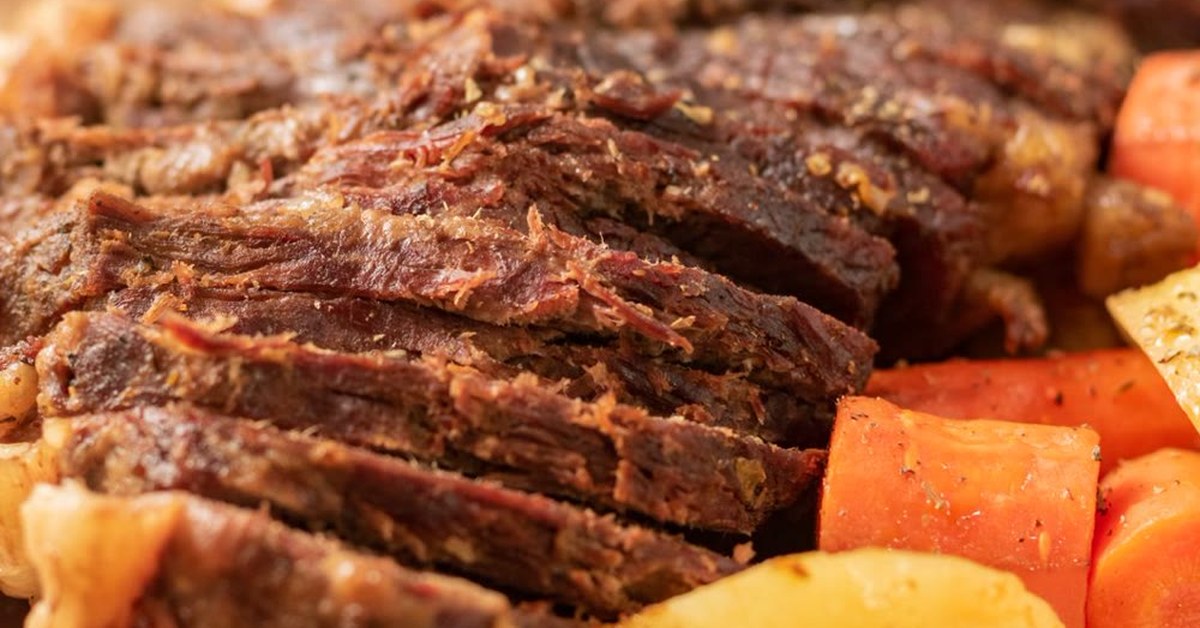
- This is the one that counts. Push a fork in and twist. Ready pot roast gives way with almost no effort and pulls apart into tender strands. If the fork meets springy resistance, it needs more time, even if it looks done.
Temperature
Beef is safe at 145°F (63°C), so pot roast passes that early. Tenderness comes much later, around 195–205°F (90–96°C), when the collagen has turned to gelatin. Leftovers should be reheated to 165°F (74°C).
Most of this cook happens in a closed oven, but the stovetop part is where Pan helps: it watches the sear and lets you know when each side is browned and ready to turn.
Tips for a tender, flavorful pot roast
- Don't rush the sear. A roast that's moved too early sticks and tears. Wait until it lets go of the pot by itself.
- Keep it low. A bare simmer at 300–325°F makes silky meat. Higher heat tightens the fibers and pushes out moisture.
- Add the vegetables later. Potatoes and carrots added at the start turn mushy. The last 1–1½ hours is plenty.
- Brown the onions well. Our guide on how to sauté onions shows how far to take them for deep flavor.
- Make it a day ahead. The flavor deepens overnight, and the fat sets on top so it lifts right off.
- Brighten at the end. A splash of red wine vinegar or a handful of chopped parsley just before serving wakes up the rich sauce.
What to serve with pot roast
The potatoes and carrots in the pot make it a full meal, but a bowl of creamy mashed potatoes for the gravy is hard to beat. Crusty bread, buttered egg noodles, green beans or a crisp salad all work well alongside.
If you skip the carrots in the pot, roast or glaze them on the side using our guide on how to cook carrots. Leftovers make great sandwiches, hash or a quick beef ragù over pasta. Want a roast that slices instead of shreds? A pork loin roast is done in about an hour.
No roasting pan needed: see what a Dutch oven is and why it's ideal for braising.
Brisket braises the same way; see what brisket is and why it needs low, slow heat.
Frozen carrots work here too; see can you freeze carrots.
Pan watches it for you
Pan tells you when to turn the roast
Pan watches the sear on the stovetop, where timing matters most. It tells you when each side has a deep brown crust and is ready to turn, and when the onions and tomato paste have darkened enough to add the liquid.
- Gray, wet surface turning to a dark brown crust: turn to the next side
- Roast releasing easily from the pot: the sear is done
- Tomato paste turning from bright red to brick red: pour in the wine
- Liquid at a gentle, lazy simmer: cover and move to the oven
Pan AI is on iPhone • Android.
Common questions
How long does pot roast take in the oven?
A 3–4 lb chuck roast takes about 3–4 hours covered at 300–325°F (150–165°C). Larger roasts take longer. Go by tenderness rather than the clock: it's ready when a fork slides in and twists easily.
What temperature should pot roast reach?
Beef is safe at 145°F (63°C), but pot roast isn't tender until the connective tissue melts, which happens around 195–205°F (90–96°C). That's where it shreds with a fork.
What is the best cut for pot roast?
Chuck roast, also sold as chuck eye, shoulder or 7-bone roast. It has plenty of marbling and collagen that turns silky in a long braise. Brisket and bottom round work too, but slice rather than shred.
Why is my pot roast tough?
It usually needs more time, not less. Chuck goes through a firm stage before it softens. Put the lid back on and check every 30 minutes until a fork twists easily.
How much liquid do you need for pot roast?
Enough to come about halfway up the side of the roast, usually 2–3 cups (475–710 ml) in a 5–6 quart Dutch oven. The top part browns and the bottom braises.
Can I make pot roast ahead?
Yes, and it's even better the next day. Cool it in its juices, refrigerate up to 4 days, lift off the fat, and reheat covered at 325°F until it reaches 165°F (74°C).
Sources
- USDA FSIS: Safe Minimum Internal Temperature Chart
- USDA FSIS: Leftovers and Food Safety
- RecipeTin Eats: Slow Cooker Beef Pot Roast
- Jessica Gavin: Slow Cooker Pot Roast
Reviewed against USDA FSIS guidance. How we choose sources and fix mistakes: editorial policy.
Keep cooking
- Vegetables & fruitHow to Make Mashed PotatoesBoil peeled Yukon Gold chunks in salted water 15–20 minutes until a fork slides in, then mash with warm butter and milk. Ratios, times and fixes inside.
- Thanksgiving & holidaysHow to Make GravyMake gravy with a roux: cook 2 tbsp fat and 2 tbsp flour for 2–3 minutes, whisk in 1 cup warm broth, and simmer 5–8 minutes until it coats a spoon.
- Vegetables & fruitHow to Cook CarrotsGlaze sliced carrots on the stove for 12–15 minutes, or roast them at 425°F for 25–30 minutes until tender and caramelized. Times, cues and holiday tips.
- Vegetables & fruitHow to Sauté OnionsSauté onions in 1 tablespoon of fat over medium heat: soft in 5 minutes, golden in 10 to 15, caramelized in 40+. Plus quick green bean and shrimp sautés.
- Soups & stewsHow to Make Beef StewMake beef stew by browning chuck in batches, then simmering it in a Dutch oven for 2–2½ hours until fork-tender. Exact times, cues and vegetable timing.
- Soups & stewsHow to Make French Onion SoupMake French onion soup by caramelizing onions 45–60 minutes over medium-low heat, simmering them in beef broth 20–30 minutes, then broiling cheese toast on top.
- Free toolInternal temperature chartSafe and perfect internal temperatures for steak, chicken, salmon, pork and more, plus a printable PDF.
- Free toolReheating guideHow to reheat fried chicken, steak, prime rib, rice and 20+ leftovers so they taste fresh.