How to Make Black Eyed Peas on the Stove
Quick answer
To make black eyed peas, rinse 1 pound (450 g) of dried peas and pick out any stones. Soften onion with smoked meat or olive oil, add the peas, 6–8 cups of broth or water and a bay leaf, boil, then simmer partly covered: 30–45 minutes if soaked, 60–75 if not. Salt in the last 15 minutes. Canned peas need 10 minutes.
Handy for this: New Year's Eve party food planner · Boiling times chart
At a glance
- Rinse 1 pound of dried black-eyed peas in a colander and pick out any small stones or shriveled peas.
- Soak them 4–8 hours in cold water if you have time, then drain; or skip the soak and allow extra simmer time.
- Cook diced bacon or smoked sausage, or warm olive oil, with 1 diced onion and 2 cloves garlic for 5 minutes.
- Add the peas, 6–8 cups of broth or water and a bay leaf, and bring to a boil.
- Lower to a gentle simmer, partly covered: 30–45 minutes for soaked peas, 60–75 minutes for unsoaked.
- Add 1½ teaspoons salt in the last 15 minutes and check that the liquid still covers the peas.
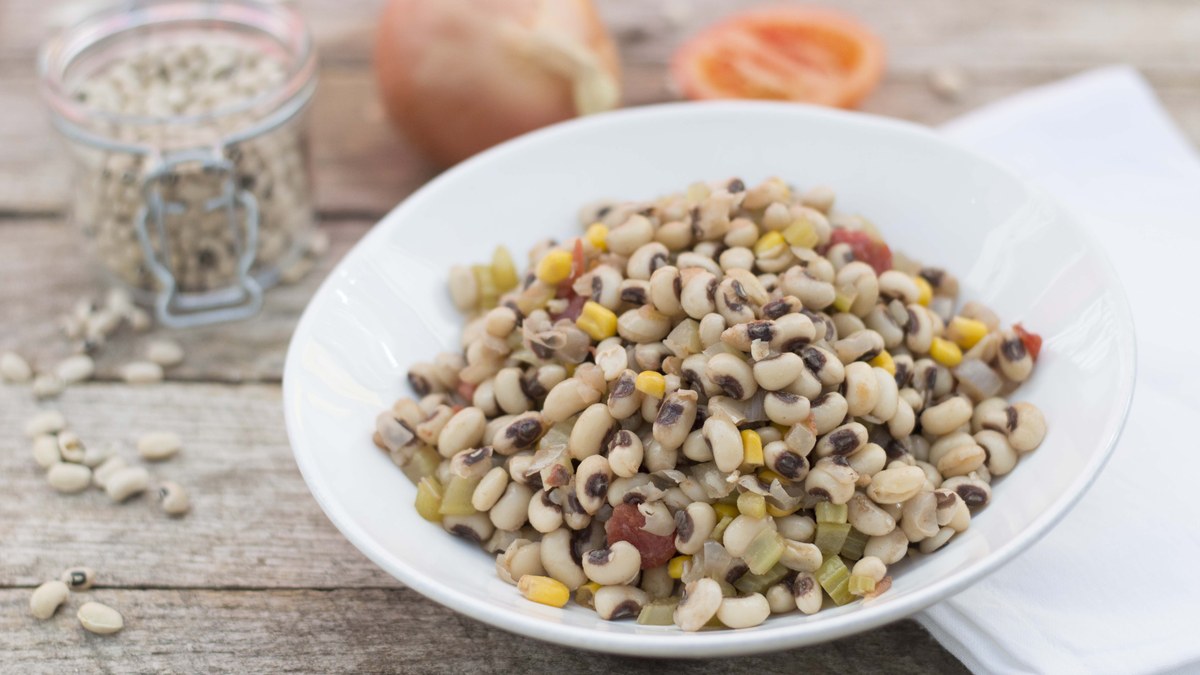
- Taste a few peas; they are done when creamy all the way through but still holding their shape.
The short version
Black-eyed peas are one of the easiest dried legumes to cook. They don't need soaking, they cook faster than most beans, and they soak up whatever you season them with. Rinse a pound of dried peas, simmer them gently in broth with onion, garlic and something smoky, and taste them after 30–45 minutes if soaked or about an hour if not. They're done when they're creamy inside but still holding their shape.
In much of the American South, black-eyed peas are the first thing people eat on New Year's Day, served with collard greens and cornbread for luck in the year ahead. This guide covers dried peas (soaked and unsoaked), canned peas, the stovetop cues that tell you they're ready, and how to turn them into Hoppin' John.
What you need
This makes about 6 cups of cooked peas, enough for 8 servings as a side, or 4–6 as a main with rice.
- 1 pound (450 g) dried black-eyed peas. One pound of dried peas gives about 6 cups cooked. Look for a bag with a recent date; fresher peas cook faster and more evenly.
- Something smoky: 4 slices of thick-cut bacon, a smoked ham hock, smoked turkey wing, or 6 ounces (170 g) of smoked sausage. For a meatless pot, use 2 tablespoons of olive oil and ½ teaspoon smoked paprika.
- 1 medium onion and 2 garlic cloves. A diced celery rib and half a green bell pepper make it more traditional.
- 6–8 cups (1.4–1.9 L) liquid. Chicken broth, vegetable broth, water, or a mix. Use the smaller amount for soaked peas.
- Seasoning: 1 bay leaf, 1½ teaspoons kosher salt, ½ teaspoon black pepper, a pinch of red pepper flakes, and hot sauce or cider vinegar for the table.
- Tools: a heavy pot or Dutch oven with a lid, a colander and a ladle.
To soak or not to soak
You can do either. Soaking isn't required for black-eyed peas, but it shortens the cooking time and helps them cook evenly.
- Overnight soak: cover the rinsed peas with 3 inches (7–8 cm) of cold water and leave them 4–8 hours. Drain and rinse.
- Quick soak: cover with water, bring to a boil, boil 2 minutes, then turn off the heat, cover and let sit 1 hour. Drain and rinse.
- No soak: rinse and go. Plan on an extra 25–35 minutes of simmering and an extra cup or two of liquid.
How to cook dried black-eyed peas on the stove
- Rinse and sort. Spread the dried peas on a sheet pan or in a colander and pick out any tiny stones, debris or shriveled peas. Rinse well under cold water.
- Build the flavor base. Set the pot over medium heat. Cook diced bacon or sausage for 5–6 minutes until the fat renders and the edges brown. If you're using a ham hock, just add it with the liquid later. For a meatless pot, warm the olive oil. Add the onion (and celery and pepper if using) and cook 5 minutes until soft, then the garlic for 30 seconds. The guide to sautéing onions has more on getting them soft and sweet.
- Add peas and liquid. Add the peas, the bay leaf, pepper flakes and 6 cups (1.4 L) of liquid for soaked peas or 8 cups (1.9 L) for unsoaked. The liquid should cover the peas by about 2 inches (5 cm).
- Boil, then lower the heat. Bring to a boil over high heat, skim off any gray foam with a spoon, then drop the heat to low. You want a gentle simmer with small bubbles breaking the surface every second or two, not a rolling boil. Hard boiling splits the skins and turns the peas mushy outside before the centers soften.
- Simmer partly covered. Set the lid slightly ajar. Soaked peas need 30–45 minutes; unsoaked peas need 60–75 minutes. Stir every 15 minutes and check that the liquid still covers the peas. Add hot water a cup at a time if it drops.
- Salt near the end. When the peas are almost tender, about 15 minutes before you expect them to be done, stir in the salt.
- Taste and finish. Taste several peas. When they're creamy all the way through, fish out the bay leaf (and the ham hock: pull the meat off the bone, chop it and stir it back in). Let the pot rest off the heat for 10 minutes so the peas finish absorbing the broth.
How to cook canned black-eyed peas
Canned peas are fully cooked and ready in about 15 minutes, which makes them a good shortcut for a busy New Year's Day. Drain and rinse two 15-ounce (425 g) cans. In a saucepan, cook 2 slices of chopped bacon or 1 tablespoon of oil with ½ diced onion for 5 minutes. Add the peas, 1 cup (240 ml) of broth, a pinch of pepper flakes and a few grinds of pepper. Simmer uncovered 10 minutes, stirring now and then, until the liquid reduces a little and the peas taste seasoned. Canned peas are already salted, so taste before adding any.
Black-eyed peas cooking time chart
| Type | Amount | Liquid | Simmer time | Cooked yield |
|---|---|---|---|---|
| Dried, soaked 4–8 hours | 1 lb (450 g) | 6 cups (1.4 L) | 30–45 min | About 6 cups |
| Dried, quick-soaked | 1 lb (450 g) | 6–7 cups (1.4–1.65 L) | 35–50 min | About 6 cups |
| Dried, unsoaked | 1 lb (450 g) | 8 cups (1.9 L) | 60–75 min | About 6 cups |
| Canned, drained | 2 cans (15 oz / 425 g each) | 1 cup (240 ml) | 10 min | About 3 cups |
| Frozen | 1 lb (450 g) | 4 cups (950 ml) | 25–35 min | About 4 cups |
Older peas and hard water both push times toward the long end. Our boiling times chart lists other beans and grains if you're cooking several things at once.
“The peas have been at a gentle simmer for a while and the liquid is getting low. Add a cup of hot water and taste a few for doneness.”
How to tell when black-eyed peas are done
Sight
- The peas swell and their skins look smooth instead of wrinkled. A few skins start to split, and the black "eye" stays dark.
- The cooking liquid turns cloudy and slightly thick, almost like a light broth. That starchy "pot liquor" is good; don't drain it.
Sound
- A good simmer makes a soft, steady blip. A loud rolling rumble means the heat is too high.
Touch and taste
- Press a pea between your thumb and finger. It should squash easily into a smooth paste. Then taste three or four from different spots in the pot; one tender pea doesn't mean they all are.
- If there's any chalky or gritty center, give it another 10 minutes and test again.
Timing
Set a timer for the earliest check (30 minutes soaked, 60 minutes unsoaked) and taste from there. Pan can also keep an eye on the pot and tell you when the simmer is too hard or the liquid has dropped below the peas.
Hoppin' John for New Year's Day
Hoppin' John is black-eyed peas and rice cooked or served together, usually with smoked pork, onion and a little heat. The simplest way: cook the peas as above, then spoon them over hot white rice with some of their liquid, and top with sliced green onion and hot sauce. For the full one-pot version, with rice simmered right in the pea broth, see our Hoppin' John recipe. For the rice on the side, the rice to water ratio calculator gives exact amounts.
The New Year's plate is traditionally peas for coins, greens for paper money and cornbread for gold. If you're hosting the night before, our New Year's Eve party food planner helps you figure out how much to make, and the peas can be cooked a day ahead so January 1 stays easy.
Serving with collard greens
Collards and black-eyed peas go together on the same plate and often in the same pot. Wash 1 bunch (about 1 pound / 450 g) of collards, strip out the stems, and slice the leaves into ½-inch (1 cm) ribbons. Simmer them in 2 cups of broth with a little of the smoky meat for 30–45 minutes until silky, then add a splash of cider vinegar. If you prefer a quicker green, the method in our kale guide works for collards too, with a few extra minutes of cooking. A pan of cornbread finishes the meal.
Fixes and tips
- Still firm after the expected time. Keep simmering in 10-minute stretches. Add hot water, not cold, so the simmer doesn't stall.
- Mushy and split. The heat was too high. They still taste great; mash some into the broth and serve them over rice.
- Bland. Add salt first, then a splash of cider vinegar or hot sauce. Acid brightens beans a lot.
- Adding tomatoes. Stir in a can of diced tomatoes only after the peas are tender, since acid slows softening.
- Too soupy. Simmer uncovered for 10 minutes, or mash ½ cup of peas against the side of the pot to thicken the liquid.
Storage and leftovers
Cool cooked peas in their liquid and refrigerate within 2 hours. They keep 3–4 days in a covered container, and they taste even better on day two. Freeze them with enough liquid to cover for up to 6 months. Reheat on the stove over medium heat with a splash of water until steaming hot all the way through, or see the reheating guide for other methods. Leftover peas are good in salads with chopped peppers and vinaigrette, mashed into fritters, or stirred into a pot of vegetable soup.
Pan watches it for you
Pan keeps the simmer gentle and the water level up
Black-eyed peas need an hour of quiet simmering, and the two things that go sideways are a boil that's too hard and a pot that runs low. Pan watches the surface and the liquid level and tells you when to turn the heat down, add water, or start tasting.
- Rolling boil with foam rising: skim the foam and drop the heat to a gentle simmer
- Small, lazy bubbles breaking the surface: the simmer is right, leave it
- Peas peeking above the liquid: add 1 cup of hot water
- Liquid turning cloudy and a few skins splitting: start tasting for doneness
Pan AI is on iPhone • Android.
Common questions
Do you have to soak black-eyed peas?
No. Black-eyed peas are small and thin-skinned, so they cook without soaking. Unsoaked peas take about 60–75 minutes at a simmer. Soaking 4–8 hours cuts that to 30–45 minutes and gives slightly more even texture.
How long do you cook canned black-eyed peas?
Canned peas are already cooked. Drain and rinse them, then simmer 10 minutes with sautéed onion, garlic and a cup of broth so they absorb flavor. Two 15-ounce (425 g) cans equal about 3 cups of cooked peas.
Why do people eat black-eyed peas on New Year's Day?
It's a Southern US tradition for good luck in the coming year. The peas are said to stand for coins, the collard greens served alongside for paper money, and cornbread for gold. Many families serve them as Hoppin' John.
How do you know when black-eyed peas are done?
Taste three or four from different parts of the pot. Done peas are creamy in the center with no chalky bite, and the skins are just starting to split on a few. The cooking liquid also turns cloudy and slightly thick.
Why are my black-eyed peas still hard?
Older dried peas take longer, and hard water or acidic ingredients like tomatoes can slow softening. Keep simmering in 10-minute stretches, adding hot water if the level drops, and add tomatoes or vinegar only once the peas are tender.
Can you freeze cooked black-eyed peas?
Yes. Cool them in their liquid, then freeze in containers with enough liquid to cover for up to 6 months. Thaw in the fridge overnight and reheat on the stove until steaming hot.
Sources
Reviewed against USDA FSIS guidance. How we choose sources and fix mistakes: editorial policy.
Keep cooking
- Thanksgiving & holidaysHow to Make Hoppin' JohnMake Hoppin' John on the stove: simmer black-eyed peas with a smoked ham hock until tender and serve over rice. Dried or canned peas, collards and cornbread.
- Rice, pasta, grains & beansHow to Cook Black BeansSimmer soaked black beans for 1–1½ hours, or unsoaked for 1½–2 hours, until creamy inside. Canned black beans just need 5–10 minutes with aromatics.
- Vegetables & fruitHow to Cook KaleSauté chopped kale in olive oil over medium heat for 5–7 minutes with a splash of water until bright green and tender. Prep, times and doneness cues.
- Rice, pasta, grains & beansHow to Cook ChickpeasSimmer soaked dried chickpeas for 1–1½ hours until creamy, or pan-roast canned chickpeas in oil for 10–15 minutes until golden and crisp. Full guide.
- Start hereChatGPT for Cooking vs Pan AI: What Changes on December 11, 2026ChatGPT voice changes on Dec 11, 2026, and Live has no video. An honest ChatGPT cooking alternative that watches your pan, and where ChatGPT still wins.
- Start herePan AI vs Samsung FoodSamsung Food saves recipes, plans meals and builds shopping lists. Pan AI watches your pan and tells you when to flip. Where each one is better, side by side.
- Free toolNew Year's Eve party food plannerGuests and party hours in: appetizers per person, how many kinds, drinks, ice and toast bottles.
- Free toolBoiling times chartHow long to boil chicken, shrimp, potatoes, corn, broccoli and 30+ more foods.