How to Make Beef Wellington
Quick answer
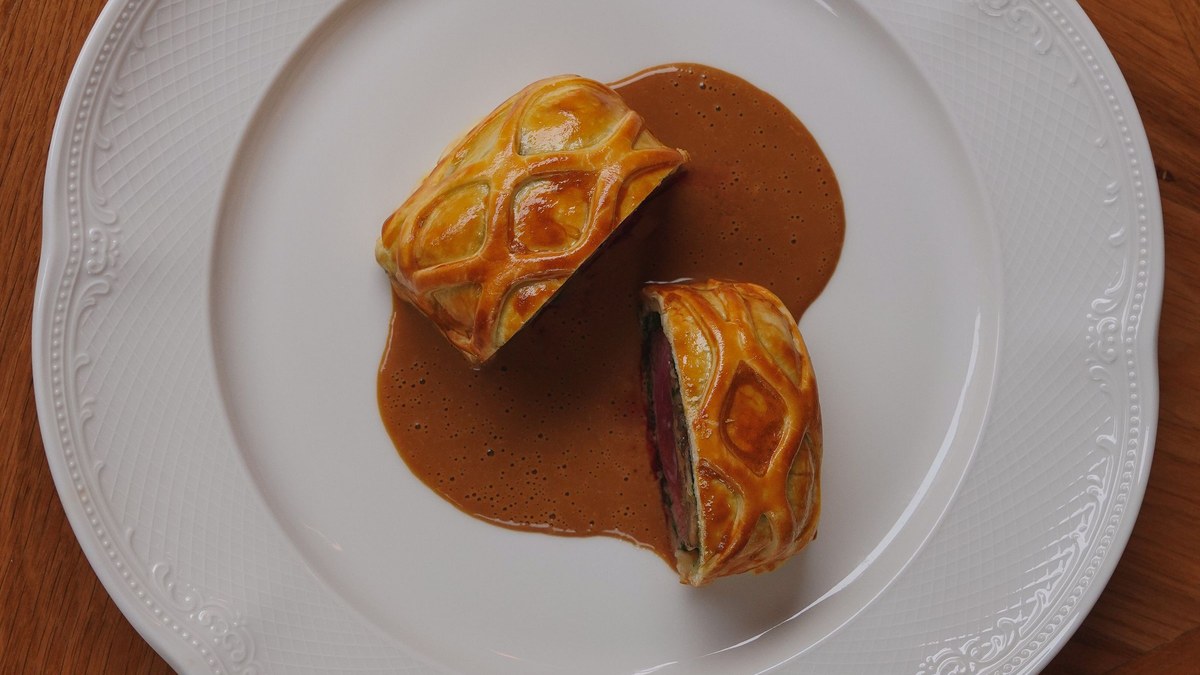
Sear a 2–2½ lb center-cut beef tenderloin, brush it with mustard and cool it. Spread a dry mushroom duxelles over overlapping prosciutto, roll the beef up tightly and chill overnight. Wrap it in puff pastry, chill 20–30 minutes, brush with egg wash and bake at 425°F (220°C) for 25–35 minutes, to 120–125°F (49–52°C) for medium-rare. Rest 10 minutes.
Handy for this: Beef tenderloin cooking time calculator · Internal temperature chart
At a glance
- Up to 2 days ahead, cook finely chopped mushrooms, shallot, garlic and thyme in butter until dry and pasty, then chill the duxelles.
- The day before, salt the tenderloin, sear it on all sides in a very hot skillet for 6–8 minutes total, and brush it with mustard while warm.
- Lay prosciutto in overlapping rows on plastic wrap, spread the cold duxelles over it, set the cooled beef on top and roll it into a tight log.
- Twist the ends of the plastic wrap like a candy wrapper and refrigerate the log overnight, or at least 2 hours.
- On the day, unwrap the log, roll it in puff pastry with the seam underneath, trim the ends and chill 20–30 minutes.
- Brush with egg wash, score the top lightly and bake at 425°F (220°C) for 25–35 minutes, until the pastry is deep golden and the center reads 120–125°F (49–52°C).
- Rest 10 minutes on the pan, then slice into 1-inch (2.5 cm) pieces with a serrated knife.
The short version
Beef Wellington looks like a big project, but most of it happens before the big day. Make the mushroom duxelles a day or two early. The day before, sear the tenderloin, roll it in prosciutto and duxelles, and chill it overnight. On the day, all you do is wrap it in puff pastry, chill it briefly, brush it with egg and bake it at 425°F (220°C) for 25–35 minutes.
Pull it when the center reads 120–125°F (49–52°C) for medium-rare. Rest it 10 minutes and it settles around 130°F (54°C), rosy from edge to edge under a crisp, flaky crust.
What you need
- Beef. A 2–2½ lb (900 g–1.1 kg) center-cut beef tenderloin, sometimes sold as chateaubriand. Ask for it trimmed of silverskin. An even, cylinder-shaped piece about 3 inches (7–8 cm) across cooks evenly. Season it with 1½ teaspoons kosher salt and 1 teaspoon black pepper, and have 2 tablespoons neutral oil for searing.
- Mustard. 2 tablespoons Dijon or English mustard, brushed on the warm beef.
- For the duxelles. 1½ lb (680 g) cremini mushrooms, 2 shallots, 3 cloves garlic, 2 teaspoons fresh thyme leaves, 2 tablespoons unsalted butter and, if you like, ¼ cup (60 ml) dry sherry or white wine.
- Prosciutto. 10–12 thin slices, about 5 oz (140 g). It holds the duxelles in place and keeps moisture away from the pastry.
- Pastry. 1 sheet (14 oz / 400 g) all-butter puff pastry, thawed in the fridge overnight, plus 1–2 tablespoons flour for dusting the counter.
- Egg wash and finish. 1 large egg beaten with 1 tablespoon water, and a pinch of flaky salt for the top.
- Tools. A heavy skillet, a food processor (or a sharp knife and patience), plastic wrap, a rimmed sheet pan, an instant-read thermometer and a serrated knife for slicing.
The searing and doneness numbers here come straight from our guide on how to cook beef tenderloin, which is worth a read if you've never handled this cut.
How to make beef Wellington, step by step
- Make the duxelles (1–2 days ahead). Pulse the mushrooms, shallots and garlic in a food processor until they look like coarse crumbs. Melt the butter in a wide skillet over medium-high, add the mushrooms and thyme, and cook, stirring often, for 15–20 minutes. They'll release a lot of liquid, then it cooks off. Add the sherry, if using, and keep going until the pan is dry and the mixture clumps together like a thick paste. Season, cool and refrigerate.
- Sear the beef (the day before). Pat the tenderloin dry and season it all over. Heat the oil in a heavy skillet until it shimmers and just starts to smoke. Sear the beef 1½–2 minutes per side, turning it to brown every surface, including the ends, about 6–8 minutes total. You want a deep brown crust, not a cooked-through roast.
- Mustard while warm. Move the beef to a plate and brush it all over with mustard. Let it cool to room temperature, about 20 minutes.
- Build the log. Lay two overlapping sheets of plastic wrap on the counter. Shingle the prosciutto on top in a rectangle a little wider than the beef is long. Spread the cold duxelles over it in a thin, even layer. Set the beef at the near edge and use the plastic to roll everything into a snug cylinder.
- Chill overnight. Twist the plastic ends tight like a candy wrapper, which firms up the shape, and refrigerate at least 2 hours or up to 24 hours. Cold, firm logs are much easier to wrap in pastry.
- Wrap in pastry (the day of). Put a rimmed sheet pan in the oven and preheat to 425°F (220°C). Roll the puff pastry on a lightly floured counter just large enough to wrap the log with a 1-inch overlap. Unwrap the log, set it on the pastry, brush the edges with egg wash and roll it up. Press the seam closed, tuck it underneath, and fold or trim the ends. Chill 20–30 minutes.
- Bake. Brush the whole thing with egg wash, score the top lightly in a crosshatch without cutting through, and sprinkle with flaky salt. Slide it onto the hot sheet pan on a piece of parchment. Bake 25–35 minutes, until the pastry is deep golden and the thickest part reads 120–125°F (49–52°C).
- Rest and slice. Rest 10 minutes on the pan. Slice into 1-inch (2.5 cm) pieces with a serrated knife, using gentle sawing strokes so the pastry stays in one piece.
If the top browns before the center is ready, lay a loose sheet of foil over it and keep going.
Beef Wellington timing and temperature chart
For a 2–2½ lb (900 g–1.1 kg) center-cut tenderloin wrapped straight from the fridge and baked at 425°F (220°C). Thicker roasts need more time, so trust the thermometer over the clock.
| Doneness | Pull from oven | After 10 min rest | Approx. bake time |
|---|---|---|---|
| Rare | 115°F (46°C) | 120–125°F (49–52°C) | 22–28 min |
| Medium-rare | 120–125°F (49–52°C) | 130°F (54°C) | 25–35 min |
| Medium | 130–135°F (54–57°C) | 140°F (60°C) | 35–40 min |
| USDA safe minimum | 145°F (63°C), 3-minute rest | 145–150°F (63–66°C) | 40–45 min |
Here's how that plays out for a Christmas dinner at 5 pm on Friday, December 25:
| When | What to do |
|---|---|
| Wednesday, Dec 23 | Make the duxelles. Move the puff pastry from freezer to fridge. |
| Thursday, Dec 24 | Sear the beef, brush with mustard, roll in prosciutto and duxelles, chill overnight. |
| Friday, 3:45 pm | Preheat the oven and sheet pan to 425°F (220°C). Wrap the log in pastry and chill. |
| Friday, 4:15 pm | Egg wash, score and bake. |
| Friday, 4:40 pm | Start checking the center temperature. |
| Friday, 4:45–4:50 pm | Pull at 120–125°F and rest 10 minutes. |
| Friday, 5:00 pm | Slice and serve. |
Need a time for a bare roast instead? Our beef tenderloin cooking time calculator works it out by weight and doneness.
“The pastry is deep golden and the sides are puffed. Check the center now, you're close to 120°F.”
How to tell when beef Wellington is done
You can't see the beef once it's wrapped, so the pastry and the thermometer do the talking.
Sight
- The pastry goes from pale and glossy to puffed and deep golden brown, with the scored lines opening slightly. Pale pastry in the folds at the ends means it needs a few more minutes.
- A little juice bubbling at the seam is normal near the end. Lots of juice pooling on the pan usually means the beef is heading past medium.
Sound
- A gentle sizzle from the pan when you open the oven means the butter in the pastry is cooking and the bottom is crisping. Silence and a pale bottom crust suggest the pan wasn't hot enough.
Smell
- Toasty, buttery pastry is the first smell, followed by browned mushrooms and thyme as the inside heats through.
Touch
- The pastry should feel crisp and firm when tapped with a spoon. Soft, bready pastry needs more time.
- Slide the pan out and lift a corner with a spatula. The bottom should be golden, not white.
Temperature
Slide an instant-read thermometer in from one end, angled toward the very center of the thickest part. Pull at 120–125°F (49–52°C) for medium-rare. USDA's safe minimum internal temperature for whole cuts of beef is 145°F (63°C) with a 3-minute rest. Many cooks enjoy tenderloin medium-rare; that's a personal choice, the same as with steak, and 145°F is the one to use for guests who are pregnant, older, very young or immunocompromised. Every level is on our doneness temperatures chart.
The stovetop parts are where timing slips. That's where Pan helps: it watches the sear and the mushrooms and tells you when each side is browned and when the duxelles is dry enough to use.
Tips for a crisp, even Wellington
- Dry duxelles is everything. If the mushrooms are still wet, they steam the pastry from the inside. Cook them until a spoon drawn through the pan leaves a clean trail.
- Cool before you wrap. Warm beef or warm duxelles melts the butter in the pastry before it reaches the oven, and it won't puff.
- Keep everything cold. Work quickly with the pastry, and pop it back in the fridge for 10 minutes if it gets soft and sticky.
- Preheat the sheet pan. A hot pan hits the bottom crust straight away, which is the best defense against a soft base.
- Thin, even pastry. Trim away thick double layers at the ends. They stay doughy while the rest is done.
- Shop for shape. A center-cut piece of even thickness cooks evenly. If yours tapers, fold the thin end under and tie it.
- Use the drippings. Deglaze the searing skillet with a splash of wine and stock for a quick sauce, or follow our gravy guide for something thicker.
What to serve with beef Wellington
Keep the sides simple and let the Wellington be the show. Creamy mashed potatoes or crisp roast potatoes, bright green beans and a red wine sauce are classic. Something green and sharp, like a lemony salad, cuts through the richness.
Cooking it for Christmas? The Christmas dinner planner works backward from the time you eat and gives you a minute-by-minute timeline for the main and the sides, and our Christmas dinner cooking guide has times for prime rib, ham and turkey in one place.
The Wellington needs the oven at 425°F for its last 40 minutes, so plan the other dishes around it. Our holiday oven schedule shows how to fit roasts and sides into one oven. Serving a bigger crowd or prefer a bone-in roast? Our guide on how to cook prime rib is the other great holiday centerpiece.
Pan watches it for you
Pan tells you when the sear and the duxelles are ready
Pan watches the skillet while you sear the beef and cook the mushrooms down. It speaks up when every side has a deep brown crust and when the duxelles has gone from wet to a dry, pasty spread.
- Beef releases from the pan and the bottom is deep brown: turn to the next side
- Mushrooms stop hissing and the pan looks dry: duxelles is close
- Duxelles pulls away from the pan in a clump when stirred: take it off the heat
- Pastry deep golden and puffed at the sides: check the center temperature
Pan AI is on iPhone • Android.
Common questions
Can you make beef Wellington the day before?
Yes. Make the duxelles 1–2 days ahead, then sear the beef and roll it in prosciutto and duxelles the day before. Chill that log overnight in plastic wrap and add the puff pastry on the day. You can also wrap it fully in pastry the night before; the bottom crust just ends up a little softer.
What temperature do you bake beef Wellington at?
425°F (220°C) on a preheated sheet pan. That heat puffs and browns the pastry in about the same time it takes the center of a 2–2½ lb tenderloin to reach medium-rare, usually 25–35 minutes.
What internal temperature should beef Wellington be?
Pull it at 120–125°F (49–52°C) for medium-rare. It climbs about 5–10°F while it rests and lands around 130°F (54°C). USDA's safe minimum for whole beef cuts is 145°F (63°C) with a 3-minute rest, which is the target for anyone at higher risk.
How do you keep the bottom of a Wellington from getting soggy?
Cook the duxelles until it's completely dry, use prosciutto as a moisture barrier, chill the log well, and bake on a sheet pan that's been preheating in the oven. A thin layer of crepe under the pastry is another classic trick.
How long should beef Wellington rest?
About 10 minutes. That lets the juices settle and the pastry firm up so it slices cleanly. Much longer and the pastry starts to soften from the steam inside.
Can you freeze beef Wellington?
You can freeze the fully wrapped, unbaked Wellington for up to a month. Thaw it in the fridge for 24 hours, then bake as usual. Expect the pastry to puff a little less than fresh.
Sources
- USDA FSIS: Safe Minimum Internal Temperature Chart
- RecipeTin Eats: Beef Wellington
- FoodSafety.gov: Safe Minimum Internal Temperatures
Reviewed against USDA FSIS and FoodSafety.gov guidance. How we choose sources and fix mistakes: editorial policy.
Keep cooking
- Meat & poultryHow to Cook Beef TenderloinSear a tied beef tenderloin on all sides, roast at 425°F for 25–35 minutes, pull at 120–125°F for medium-rare and rest 15 minutes. Times by weight and cues.
- Thanksgiving & holidaysHow to Cook Prime RibSear prime rib at 450°F for 15–20 minutes, then roast at 325°F about 13–15 minutes per pound to 120°F for medium-rare. Charts, reverse sear and carving.
- Thanksgiving & holidaysHow to Make Roast PotatoesParboil potatoes 8–10 minutes, rough them up, then roast in hot fat at 425°F (220°C, gas 7) for 45–60 minutes, turning once, until crisp and golden.
- Thanksgiving & holidaysHoliday Oven ScheduleCook a holiday dinner in one oven: roast the main first, then bake sides at 375–400°F during its 30–60 minute rest. Includes a sample 5 pm dinner schedule.
- Thanksgiving & holidaysBoxing Day LeftoversTurn Boxing Day leftovers into bubble and squeak, turkey sandwiches, pie, hash and soup. Plus safety: chill in 2 hours, eat in 3–4 days, reheat to 165°F.
- Thanksgiving & holidaysBrown Sugar Ham GlazeSimmer brown sugar, honey, Dijon and a splash of vinegar for 3–5 minutes until it coats a spoon, then brush it on the ham in the last 15–20 minutes.
- Free toolBeef tenderloin cooking time calculatorSear, then 425°F: roast time by weight and doneness, with pull temps.
- Free toolInternal temperature chartSafe and perfect internal temperatures for steak, chicken, salmon, pork and more, plus a printable PDF.