Brown Sugar Ham Glaze
Quick answer
For a brown sugar ham glaze, simmer ¾ cup (165 g) packed brown sugar, ¼ cup (85 g) honey or maple syrup, 2 tablespoons Dijon, 2 tablespoons cider vinegar and ¼ teaspoon ground cloves for 3–5 minutes, until it coats a spoon. Brush it on the ham in 2–3 coats during the last 15–20 minutes at 400–425°F (200–220°C).
Handy for this: Internal temperature chart · Grams to cups converter
At a glance
- Add ¾ cup brown sugar, ¼ cup honey, 2 tbsp Dijon, 2 tbsp cider vinegar and ¼ tsp cloves to a small saucepan.
- Stir over medium heat until the sugar melts and the mixture comes to a simmer, about 2 minutes.
- Simmer 3–5 minutes, stirring often, until the bubbles grow big and slow and the glaze coats a spoon.
- Take the pan off the heat as soon as the edges start to darken. It thickens more as it cools.
- Uncover the ham for its last 15–20 minutes and raise the oven to 400–425°F (200–220°C).
- Brush on a third of the glaze, roast 5–7 minutes, and repeat for 2–3 coats until bubbly and amber.
The short version
A good ham glaze is just four or five things you probably have already: brown sugar, honey, mustard, something tangy and a pinch of cloves. Stir them in a small saucepan over medium heat, let them come to a simmer, and cook 3–5 minutes until the bubbles turn big and slow and the glaze coats the back of a spoon. That's it.
The timing on the ham matters more than the recipe. Brush it on only in the last 15–20 minutes of baking, at 400–425°F (200–220°C), in 2–3 coats. Any earlier and the sugar goes bitter before the ham is warm.
What you need
This makes about 1 cup (240 ml), enough for an 8–10 lb (3.6–4.5 kg) spiral or bone-in ham with a little left for the table.
- ¾ cup (165 g) packed light or dark brown sugar. Dark brown gives a deeper molasses flavor and a darker finish.
- ¼ cup (85 g) honey or maple syrup. Honey sets glossier, maple tastes woodier.
- 2 tablespoons Dijon mustard. Whole-grain works too and looks nice on the ham.
- 2 tablespoons apple cider vinegar, or ¼ cup (60 ml) pineapple or orange juice. The acid keeps it from tasting flat.
- ¼ teaspoon ground cloves. A pinch of cinnamon or ground ginger is welcome too.
- 1 tablespoon butter (optional), for a richer, shinier glaze.
- A small saucepan, a heatproof spatula and a pastry brush.
Measuring by weight is easier with sticky sugar and honey. Our grams to cups converter handles brown sugar and honey, which weigh quite differently from water.
How to make brown sugar ham glaze
- Combine everything cold. Add the brown sugar, honey, mustard, vinegar and cloves to a small saucepan. Stir until it looks like wet sand with no dry pockets.
- Melt over medium heat. Stir as the sugar dissolves, about 2 minutes. The mixture turns from grainy to smooth and glossy.
- Bring to a simmer. Small bubbles will appear at the edges, then across the whole surface. Keep the heat at medium. A hard boil can foam up and over the rim.
- Simmer 3–5 minutes, stirring often. Scrape the bottom and corners with the spatula so nothing sticks. Watch the bubbles. They start small and fast, then grow larger and pop more slowly as water cooks off.
- Test on a spoon. Dip a spoon and lift it. The glaze should coat it in an even, honey-thick layer and run off slowly. Draw a finger across the back; the line should hold for a second.
- Take it off the heat. Do this the moment the edges of the pan start to darken. Stir in the butter, if using. The glaze thickens noticeably as it cools, so it should look a little looser than you want.
- Keep it brushable. If it firms up before you need it, warm it over low heat for 30–60 seconds with a teaspoon of water.
How and when to glaze the ham
Bake the ham covered first, following our ham cooking guide. When the center is around 125°F (52°C), usually 15–20 minutes before the end, it's glaze time.
- Uncover and turn up the heat. Remove the foil and raise the oven to 400–425°F (200–220°C).
- First coat. Brush a third of the glaze over the whole ham, working it into the scored lines or between the spiral slices.
- Roast 5–7 minutes, then brush on a second coat. Repeat once more if you have glaze left.
- Finish carefully. For a crackly top, broil 1–3 minutes at the end and stay right at the oven door. Sugar goes from amber to too dark in under a minute.
- Check the ham. A fully cooked ham is ready at 140°F (60°C) in the thickest part. Rest it 15–20 minutes so the glaze sets.
Glaze timing chart
| Stage | Heat | Time | What you see |
|---|---|---|---|
| Melt | Medium | About 2 min | Grainy sugar turns smooth and glossy |
| Simmer | Medium | 3–5 min | Small fast bubbles grow big and slow |
| Off the heat | None | Cools 5 min | Coats a spoon, thickens as it sits |
| First coat on ham | 400–425°F (200–220°C) | 5–7 min | Glaze turns glossy and starts to bubble |
| Second and third coats | 400–425°F (200–220°C) | 10–13 min total | Bubbling all over, edges deep amber |
| Optional broil | Broil, high | 1–3 min | Crackly, lacquered top |
For the ham itself, our ham cooking time calculator lists 140°F (60°C) for fully cooked ham and 145°F (63°C) for raw and cook-before-eating hams.
“The bubbles just went big and slow and the edges are darkening. Take the glaze off the heat now.”
How to tell when the glaze is ready
The glaze tells you exactly where it is. Watch the bubbles more than the clock.
Sight
- At first the bubbles are small, fast and foamy. As the water cooks off, they get bigger and pop slowly, like lava. That change is the sign it's nearly done.
- A thin ring of darker sugar forms at the edges of the pan. When you see it, take the pan off the heat.
Sound
- The quick, light bubbling turns into a slower, thicker blip as it reduces. If it starts to crackle or hiss on the sides, the heat is too high.
Smell
- You'll smell warm caramel, cloves and mustard. A sharp, bitter smell means the sugar on the bottom has gone too far. Stop, and start a fresh batch; it only takes 10 minutes.
Touch
- Dip a spoon and run your finger across the back once it has cooled a few seconds. A clean line that holds means it's thick enough. On the ham, a ready glaze feels tacky, not wet.
Temperature
You don't need a thermometer for the glaze, but if you use one, it's ready at about 215–220°F (102–104°C). The ham under it is what needs checking, at 140°F (60°C) for a fully cooked ham. Pan is handy here because the simmer moves fast: it watches the bubbles and the color at the edge of the pan and tells you when to take it off the heat.
Three easy variations
Honey mustard glaze
Use ½ cup (120 g) brown sugar, ½ cup (170 g) honey and 3 tablespoons Dijon, plus 1 tablespoon whole-grain mustard and 2 tablespoons cider vinegar. Skip the cloves or keep a small pinch. It's tangier and sets very glossy.
Maple glaze (no alcohol)
Swap the honey for ½ cup (120 ml) pure maple syrup and use dark brown sugar. Add 1 teaspoon vanilla extract off the heat, ½ teaspoon cinnamon and 1 tablespoon orange juice instead of the vinegar. You get the warm, oaky depth people expect from a bourbon glaze without any alcohol.
Pineapple glaze
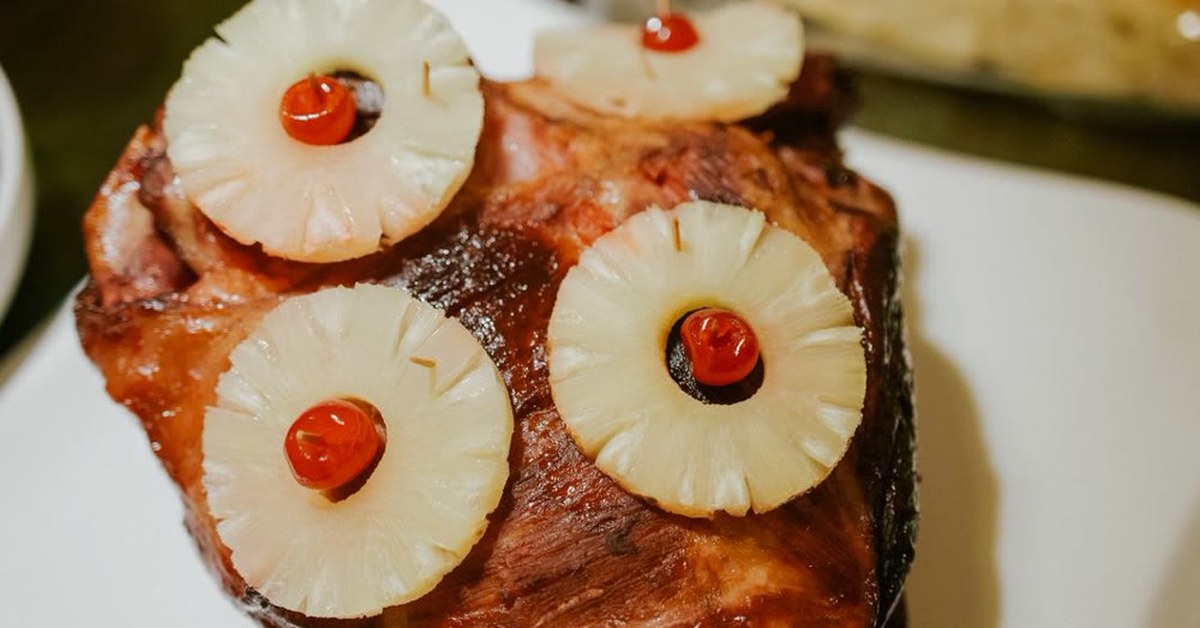
Replace the vinegar with ½ cup (120 ml) pineapple juice from a can of rings, and add ½ teaspoon ground ginger. Simmer 5–7 minutes, since there's more liquid to cook off. Pin the pineapple rings and a few cherries to the ham with toothpicks before the first coat for the retro look.
Tips
- Stay with the pan. Glaze is a 10-minute job, and the last minute matters most.
- Use a pan bigger than you think. Sugar bubbles up as it simmers. A 1–2 quart (1–2 liter) saucepan is right for one batch.
- Add water to the roasting pan. Drips of glaze on a dry pan bottom darken quickly and smoke. A thin layer of water or juice keeps them as a sauce.
- Save some for the table. Set aside a few spoonfuls before you start brushing, so you aren't serving glaze that touched the brush.
- Clean up with hot water. Fill the saucepan with water and let it sit; the sugar dissolves on its own in 10 minutes.
What to serve next
Once the ham is glazed and resting, you have 15–20 minutes for everything else. Whisk a quick pan sauce with the drippings using our gravy method, or just spoon the skimmed juices over the slices. Creamy mashed potatoes and roasted Brussels sprouts soak up the extra glaze beautifully.
Cooking it for Christmas? The Christmas dinner planner works backward from the time you eat and gives you a minute-by-minute timeline for the main and the sides, and our Christmas dinner cooking guide has times for prime rib, ham and turkey in one place.
Leftover glaze keeps 5 days in the fridge. Brush it on pork chops, salmon or roasted carrots the following week.
Out of brown sugar? How to make brown sugar takes white sugar and a spoonful of molasses.
A pinch of allspice suits ham; see substitute for allspice if you have none.
Pan watches it for you
Pan tells you when the glaze is thick enough
A sugar glaze changes fast once it's simmering. Pan watches the bubbles and the color at the edge of the pan and tells you the moment to take it off the heat.
- Small, fast bubbles all over: keep stirring, it needs a few more minutes
- Bubbles getting bigger and slower, glaze coating the spoon: almost there
- Sugar darkening at the edges of the pan: off the heat now
- Glaze rising toward the rim: turn the heat down and stir
Pan AI is on iPhone • Android.
Common questions
When should you put glaze on a ham?
Glaze in the last 15–20 minutes of baking. Uncover the ham when the center reaches about 125°F (52°C), raise the oven to 400–425°F (200–220°C), and brush on 2–3 coats, 5–7 minutes apart, until the ham reaches 140°F (60°C). Sugar added earlier turns bitter in the oven.
How much glaze do I need for a ham?
About 1 cup (240 ml) covers an 8–10 lb (3.6–4.5 kg) ham with 2–3 coats and a little left to serve on the side. Make 1½ times the recipe for a whole 12–14 lb ham.
Why is my ham glaze too thin?
It needs another minute or two on the stove. Simmer until the bubbles get big and slow and the glaze coats the back of a spoon. Remember it thickens a lot as it cools, so it should look slightly looser in the pan than you want on the ham.
Can you make ham glaze ahead?
Yes. Make it up to 5 days ahead and keep it covered in the fridge. It will set firm. Warm it over low heat for 1–2 minutes, with a teaspoon of water if needed, until it's brushable again.
Can I use the glaze packet that came with the ham?
You can, but a homemade glaze takes about 10 minutes and gives a deeper, less sugary flavor. If you use the packet, mix it with a tablespoon of Dijon and a splash of juice so it brushes on evenly.
What can I use instead of brown sugar in ham glaze?
Use all honey or all maple syrup, about ⅔ cup (225 g) in place of the brown sugar and honey together. Coconut sugar also works one-for-one. The glaze will be a little thinner, so simmer it a minute longer.
Sources
- USDA FSIS: Ham and Food Safety
- USDA FSIS: Safe Minimum Internal Temperature Chart
- Well Plated: Brown Sugar Ham Glaze
Reviewed against USDA FSIS guidance. How we choose sources and fix mistakes: editorial policy.
Keep cooking
- Thanksgiving & holidaysHow to Cook a HamHeat a fully cooked ham, covered, at 325°F (163°C) for 10–18 minutes per pound to 140°F (60°C), then glaze it for the last 15–20 minutes at 400°F.
- Thanksgiving & holidaysHow to Make GravyMake gravy with a roux: cook 2 tbsp fat and 2 tbsp flour for 2–3 minutes, whisk in 1 cup warm broth, and simmer 5–8 minutes until it coats a spoon.
- Vegetables & fruitHow to Make Mashed PotatoesBoil peeled Yukon Gold chunks in salted water 15–20 minutes until a fork slides in, then mash with warm butter and milk. Ratios, times and fixes inside.
- Thanksgiving & holidaysGreen Bean CasseroleBake green bean casserole at 350°F for 25–30 minutes, until bubbling, then add crispy onions for the last 5. Classic canned-soup and from-scratch versions.
- Thanksgiving & holidaysHow to Make Beef WellingtonMake beef Wellington by wrapping seared tenderloin in duxelles, prosciutto and puff pastry, then bake at 425°F for 25–35 minutes until it reads 120–125°F.
- Thanksgiving & holidaysBoxing Day LeftoversTurn Boxing Day leftovers into bubble and squeak, turkey sandwiches, pie, hash and soup. Plus safety: chill in 2 hours, eat in 3–4 days, reheat to 165°F.
- Free toolInternal temperature chartSafe and perfect internal temperatures for steak, chicken, salmon, pork and more, plus a printable PDF.
- Free toolGrams to cups converterConvert grams to cups (and back) for flour, sugar, butter, rice and 30 more ingredients.