How to Use a Slow Cooker Safely, From Filling to Leftovers
Quick answer
To use a slow cooker, put firm vegetables in the bottom, add thawed meat and liquid, and fill the crock half to two-thirds full. Cover and cook on low (about 8 hours for most stews) or high (about 4 hours); high takes roughly half as long. Keep the lid on, and check meat with a thermometer before serving.
Handy for this: Internal temperature chart · Thawing time calculator
At a glance
- Thaw meat and poultry completely in the fridge first.
- Cut vegetables and meat into even pieces.
- Put firm vegetables like potatoes and carrots in the bottom.
- Add the meat, seasonings and liquid on top.
- Fill the crock half to two-thirds full and cover.
- Cook on low about 8 hours or on high about 4, keeping the lid on.
- Check the meat with a thermometer, then serve or refrigerate within 2 hours.
The short version
A slow cooker is a heated crock with a lid that holds food at a low, steady temperature for hours. USDA describes the range as roughly 170–280°F (77–138°C): hot enough to cook food safely, gentle enough to turn tough cuts and dried beans tender while you are out. Almost every problem people have with slow cookers comes from three things: frozen ingredients, the wrong fill level and lifting the lid.
“The browning is done. Into the crock with it, and remember: high for the first hour, then low, and no peeking.”
Low vs high: how the settings compare
| Recipe says | On low | On high | Best for |
|---|---|---|---|
| Stew, chili, pot roast | 7–8 hours | 3½–4 hours | Tough cuts: chuck, shoulder |
| Bone-in chicken thighs | 5–6 hours | 2½–3 hours | Shredding, soups |
| Soups with raw vegetables | 6–8 hours | 3–4 hours | Bean and vegetable soups |
| Soaked dried beans | 6–8 hours | 3–4 hours | Black beans, pintos |
As a rule of thumb, one hour on high equals about two on low. Low gives more tender meat; high is for when you're short on time. Models run hotter or cooler, so learn yours with a thermometer the first few times.
How full to fill a slow cooker
USDA advises filling a slow cooker no less than half and no more than two-thirds full. Too little food and it can overcook or scorch; too much and the middle heats too slowly. Vegetables cook more slowly than meat in a slow cooker, so put dense ones like potatoes, carrots and onions in the bottom, where the heat is, with the meat on top. Use enough liquid to come about halfway up the ingredients; slow cookers lose very little to evaporation.
Food safety rules that matter
- Thaw meat first. USDA recommends always thawing meat and poultry before it goes in. Frozen pieces spend too long in the temperature range where bacteria grow.
- Start hot if you can. Setting it on high for the first hour gets food up to temperature faster, then you can switch to low.
- Keep the lid on. Each peek lets heat escape and can add up to 30 minutes to the cooking time.
- Power out while you were away? USDA says to throw the food away, even if it looks done.
- Check the meat. Poultry 165°F (74°C), ground meat 160°F (71°C), whole cuts of beef and pork 145°F (63°C).
A worked example
You set up a beef stew at 8:00 a.m. Potatoes and carrots go in the bottom, then 2½ pounds of browned chuck, an onion and 2 cups of broth, which fills the crock about two-thirds of the way. You put it on high for the first hour, then switch to low and leave the lid alone. At 4:30 p.m. the beef shreds with a fork and reads well over 145°F. You season it, ladle out dinner and refrigerate the rest in shallow containers by 7:00.
Leftovers and reheating
Don't leave cooked food sitting in the crock to cool. Move leftovers into shallow containers and refrigerate them within 2 hours; they keep 3–4 days. USDA advises against reheating leftovers in a slow cooker, because it warms too slowly. Reheat them on the stove or in the microwave until steaming, 165°F (74°C), then you can hold them in a preheated slow cooker on warm.
Common mistakes
- Raw ground meat straight in. Brown it first, for safety and flavor, and drain the fat.
- Dairy at the start. Milk, cream and cheese can curdle over hours; stir them in during the last 30 minutes.
- Too much liquid. Nothing boils off, so a stovetop recipe converted directly turns watery. Cut the liquid by about a third.
- Dried kidney beans. They must be boiled hard for 10 minutes first; a slow cooker alone doesn't get them hot enough to destroy their natural toxin.
Keep going
Next up: How to Make Beef Stew, How to Make Chili and How to Make Soup.
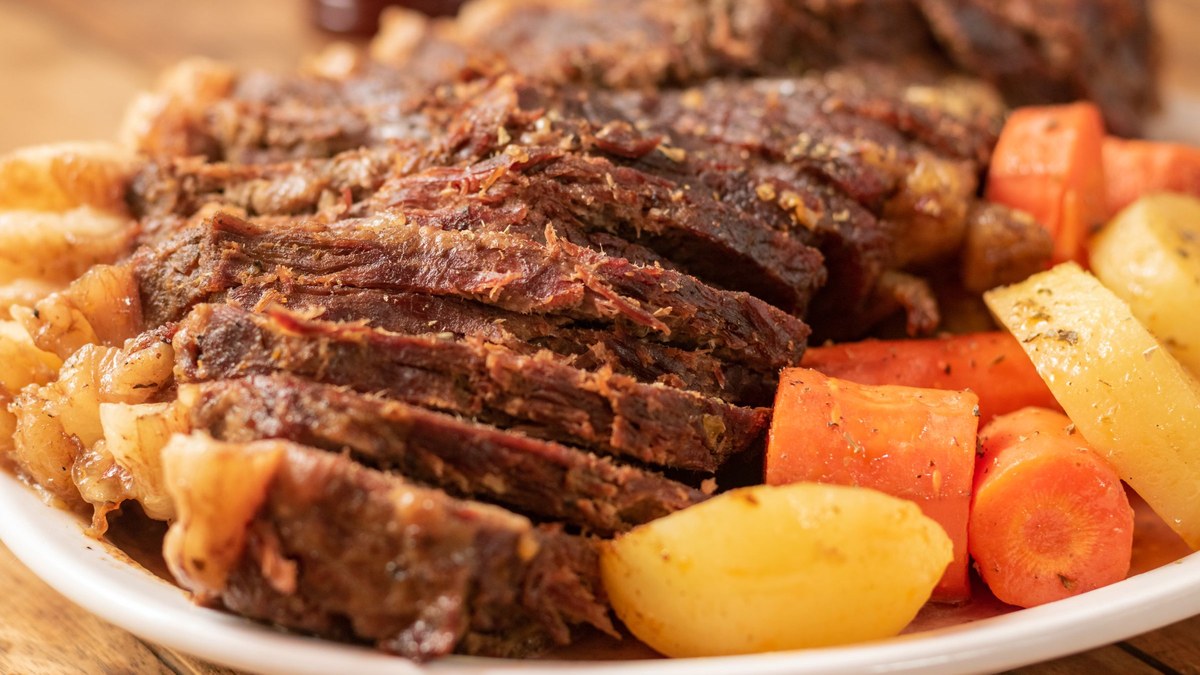
One of the best slow-cooker cuts: brisket, cooked until fork-tender.
Pan watches it for you
Pan helps with the parts before the crock
Pan watches your pan through the phone camera while you brown the meat and soften the onions, and tells you out loud when each batch is ready to go in.
- Meat browned on all sides: into the crock
- Crock two-thirds full: lid on
- First hour on high: switch to low
- Beef shreds with a fork: check the temperature
Pan AI is on iPhone • Android.
Common questions
How long does a slow cooker take on low vs high?
Most stews and roasts take 7–8 hours on low or 3½–4 hours on high. One hour on high is roughly two hours on low.
Can you put frozen meat in a slow cooker?
USDA advises against it. Thaw meat and poultry in the refrigerator first so the food heats through quickly enough to be safe.
How full should a slow cooker be?
Between half and two-thirds full. Less food can overcook, and more food can take too long to heat in the center.
Can you leave a slow cooker on all day?
Yes, that is what it is designed for. Use the low setting, keep the lid on, and follow the time in your recipe.
Is it better to cook on low or high in a slow cooker?
Low is best for tough cuts and all-day cooking; high is about twice as fast. 1 hour on high is roughly 2 hours on low.
Do you need to add liquid to a slow cooker?
Usually some, but less than on the stove, because the lid traps moisture. Most recipes need ½–1 cup.
Can you put raw meat in a slow cooker?
Yes, thawed raw meat is fine. Browning it first adds flavor but isn't required.
Sources
- USDA FSIS: Leftovers and Food Safety
- FoodSafety.gov: Safe Minimum Internal Temperatures
- USDA FSIS: Slow Cookers and Food Safety
- FoodSafety.gov: Safe Minimum Internal Temperatures
Reviewed against USDA FSIS and FoodSafety.gov guidance. How we choose sources and fix mistakes: editorial policy.
Keep cooking
- Start hereHow to Make Beef StewHow to make beef stew: brown chuck in batches, then simmer it in a Dutch oven 2–2½ hours until fork-tender. Exact times, cues and vegetable timing.
- Start hereHow to Make ChiliHow to make chili on the stove: brown beef to 160°F, bloom the spices, then simmer with tomatoes 45–90 minutes. Beans optional; times and cues inside.
- Start hereHow to Make SoupHow to make soup: soften aromatics 8–10 minutes, add stock, then simmer ingredients in order of cook time, 20–40 minutes in all. Template and timing table.
- Start hereHow to Cook Black BeansHow to cook black beans: simmer soaked beans 1–1½ hours, or unsoaked 1½–2 hours, until creamy inside. Canned black beans need just 5–10 minutes.
- Free toolInternal temperature chartSafe internal temperatures for steak, chicken, salmon, pork and more, plus a printable PDF.